
Meeting summary:
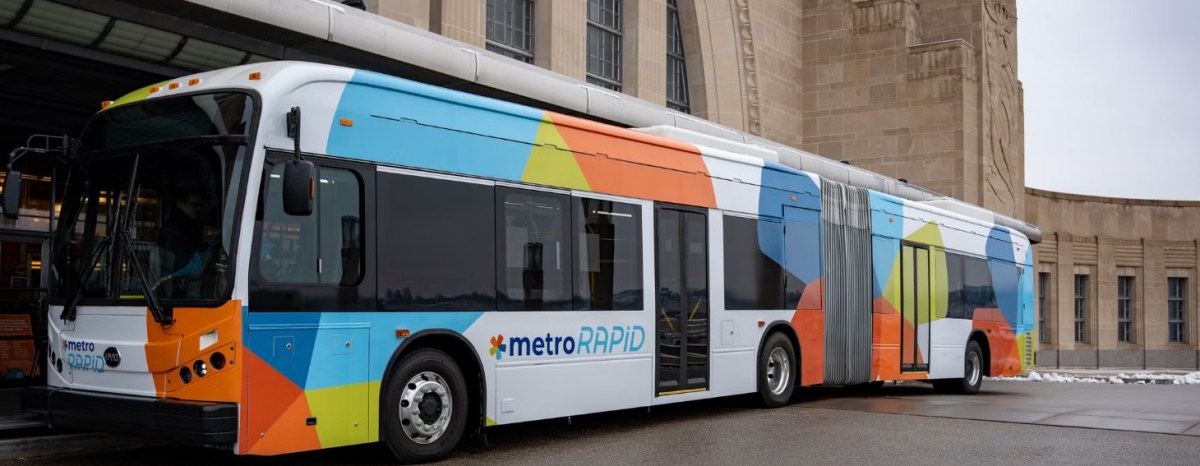
- Construction for Cincinnati’s multimillion-dollar Bus Rapid Transit, which is promised to be a speedy bus-based travel option, is on schedule to begin in spring 2027, the project designer for Metro said Tuesday.
Documenter’s follow-up question:
- The passage of Issue 7 in 2020 brought millions in new funding to Metro. Could that pot of money have been joined with Southern Railway money to expand Cincinnati’s streetcar system?
- What plans will Cincinnati and Hamilton County implement to help residents during the construction for the MetroRapid and I-75 companion bridge projects?
Notes
The meeting, held in council chambers (Room 300) at 801 Plum St., downtown, began about 10:02 a.m. and adjourned about 11:20 a.m.
Members present
Council Member Meeka Owens, committee chair
Council Member Ryan James, vice chair
Council Member Mark Jeffreys
Council Member Seth Walsh (absent)
Council Member Evan Nolan joined the committee
04 minutes: Introductions
08 minutes: Public comment
62 minutes: MetroRapid Update
04 minutes: Paul Clock Bell Tower update
The committee meeting opened with public comment. All four speakers support of the proposed benchmarking ordinance, which calls for the monitoring of energy use in large buildings. Owens said the policy is part of the 2023 Green Cincinnati Plan and hopes the full council votes on the proposed ordinance, which remains in committee, before the end of the year. Speakers were Syahirah Aziz, program manager for Power A Clean Future Ohio; Jesse Velasquez, director, Ohio Environmental Council Action Fund; Paul Yankie, president of Green Building Consulting, and Somalia Jones, manager of responsible investment policy and practices with White Oak Partners, a Westerville, Ohio, real estate company.
Agenda/Item 1
Update on the MetroRapid project
Timelines for project construction to begin in spring 2027 and launch service in 2028 (Reading Road) and 2029 (Hamilton Avenue) remain on target, said Sharyn LaCombe, senior director, Bus Rapid Transit (BRT) and Design, Metro
The MetroRapid project – lanes dedicated only to bus traffic – is part of the next federal transit authorization round of grant funding. It is one of 11 projects across the nation headed for Federal Transit Administration (FTA) approval. Tuesday morning’s update focused on changes planned at BRT transit stations and routes based on public comment.
MetroRapid arose from Issue 7, which Hamilton County voters passed in 2020. The 0.08%sales tax levy provided Metro a new funding source.
“We have legislation that helps us to inspire developers to use the property as well” around new BRT stations, LaCombe said. Metro is developing a “playbook” to help with public development in those areas. The city has applied for a Transit Oriented Development pilot program grant from the FTA. She hopes it will be awarded soon. LaCombe hopes to present the playbooks for the public in the next few weeks.
Planners are narrowing in on the project definition, which speaks to the number of stations that will be available, she said. Once both sections (Reading Road, at 9.2 miles long with 13 stations; Hamilton Avenue, at 8.8 miles long with 11 stations) are operating, buses from the University of Cincinnati to the Banks will operate every 5 minutes.
“If you’re just traveling between those two places, it will be mindless. You just walk out of the station, hop on, just like the streetcar, and it will take us all the way up to the university and the hospital district,” LaCombe said.
Metro wants the outcome to be better transit reliability, accessibility, connectivity and economic opportunity.
Beside improving travel times via those specially designed corridors, the project also will resurface 5.82 miles of streets, improve and upgrade 62 pedestrian crossings within 2 miles of the new transit stations, and offer audio enhancements for hearing-impaired residents trying to get to stations that also will be specially designed.
Sixty-foot-long BRT vehicles have been ordered, LaCombe said, noting that those vehicles will be available for use outside BRT corridors. Regular buses are 40 feet long. “We need them now. We have a lot of standing-room only during our peak period,” she said.
The project calls for three sizes of MetroRapid stations, some with large canopies and wind screens. BRT and downtown streetcar routes will share traffic lanes and signals, while special lanes will be built to accommodate BRT vehicles and stations along their routes.
“We don’t want to be a detriment to traffic,” she said, noting that a planned BRT center lane for the Vine Street hill from the Findlay Market area to the University of Cincinnati will be removed from the plan.
”The cost was too high in terms of social impacts,” she said. The BRT will go up and down the Vine Street hill just like other fixed routes. All center stations have been replaced with side stations to create less of an impact on neighborhood businesses.
As of Oct. 13, Metro has held many MetroRapid events (296) and community meetings with 11,020 participants who live along the BRT lines.
“We’re gonna have the best of the best here in Cincinnati,” she said.
“We’re really within six months of construction to start working on this project, which is very exciting,” LaCombe said. “We promised taxpayers with our levy that we would provide better bus service. This is just one of the two projects that will help get us there.”
LaCombe, responding to a question from Owens, said ridership now is at an all-time high. She and Khaled Shammout, project deputy innovation and vision officer, cited as an example the 43 (Reading Road) fixed route. The 43 serves 4,000 to 5,000 riders a day, LaCombe said, and both estimated a projected ridership of 6,000 to 7,000 a day once the new route is operational.
MetroRapid will charge the same fare as fixed bus routes, LaCombe said, and Metro is moving to implement an updated boarding process, which means riders will be able to tap credit cards or Metro cards, she said.
Council Member Mark Jeffreys said he feared the project is not ambitious enough. He asked whether the project should set a travel time reduction of 25% instead of 20%. Hartford, Connecticut, has a 50% travel reduction rate and Cleveland has a 26% reduction rate goal, he said.
Shammot said, “There are many factors that pre-determine travel times. We have certain constraints in terms of the right of way. This is our first BRT system here in Cincinnati. We want to be conservative at the beginning. As we learn and as people adjust, maybe there are things we can keep tweaking and get it higher than 20%. And I think we will.”
The committee filed the presentation.
Item 2: The Paul Clock Bell Tower
The committee held the item, by agreement, to ask the city administration for an accounting of all clock bell towers that might be owned by the city. Jeffreys worried that the city might be saddled with owning, cleaning and maintaining other clock bell towers.
If you believe anything in these notes is inaccurate, please email us at documenters@signalcincinnati.org with “Correction Request” in the subject line.
Find more Documenters’ notes here.