
Meeting summary:
- A proposed ordinance requiring owners and operators of large buildings to report how much energy those buildings consume was pulled from Cincinnati City Council consideration by Council Member Meeka Owens, who said she wants to offer a different version for consideration.
- The Cincinnati city manager has been asked to share an “after action” analysis of the recent flash floods that should offer an evaluation of what worked and what didn’t work in handling the onslaught of stormwater, including revisiting council’s decision to reject an engineering company’s recommendation to remove a bridge on Madison Road because it restricted flood water flow to Duck Creek.
Documenter’s follow-up question:
- Has the City of Cincinnati budgeted enough money to make the changes necessary to handle future flash flooding events?
Notes
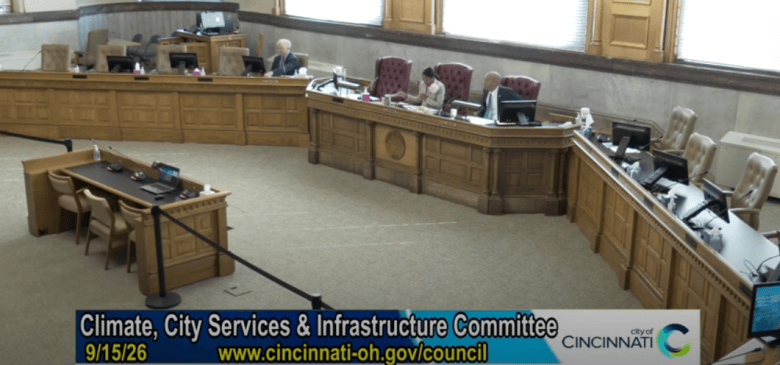
SCENE: The meeting convened at its scheduled time of 10 a.m. in Room 300 (council chambers) at City Hall, 801 Plum St., downtown, with Council Member Meeka Owens presiding as chair. She adjourned the meeting at 10:54 a.m.
Committee Members
Meeka Owens, chair
Ryan James, vice chair
Mark Jeffreys, council member
Seth Walsh, councilmember (excused)
Time Spent
01 minutes: Introductions
47 minutes: Presentation, Building Energy Benchmarking Overview
01 minutes: Building Energy Benchmarking Ordinance
01 minutes: Route 127 bridge work (I-75 project)
02 minutes: Flash flooding motion
02 minutes: Public comment
Item 1: Presentation, Building Energy Benchmarking Overview
Oliver Kroner, director, Office of Environment & Sustainability (OES), and Rob McCracken, energy manager of the same office, updated the committee on the proposed building energy benchmarking ordinance, which would require owners of large buildings to report the amount of natural gas and electricity used monthly. That information would be used to create an annual energy benchmarking report for certain large publicly and privately owned buildings and to provide for administration and enforcement of a building energy program.
This ordinance is connected to work guided by a council resolution passed in April 2023 that adopted the Green Cincinnati Plan, which includes the goal of reducing community-wide carbon emissions by 50% by 2030 and achieving neutrality by 2050.
Energy benchmarking is the practice of annually measuring and reporting a building’s energy use per square foot, providing building owners, tenants, policymakers and the public with information needed to understand building energy performance, identify opportunities for efficiency and reduce operation costs.
Research has shown that benchmarking programs across the United States can reduce energy consumption, increase market transparency, improve asset value and support long-term planning for energy infrastructure and affordability. More than 40 U.S. cities, including Columbus, have benchmarking ordinances, according to Kroner and McCracken’s presentation.
A working group of building owners, operators, industry professionals and community stakeholders already has determined that 70% of the largest buildings in Cincinnati account for a disproportionate share of total building emissions. That group of buildings represents 45% of the emissions coming from less than 1% of the building stock in Cincinnati, Kroner said.
Kroner said rains and storms that hit the city and region this spring and summer are driven by greenhouse emissions.
Under the proposed benchmarking policy that would be part of the ordinance:
- Reporting would begin June 1, 2027, for city properties greater than 10,000 square feet;
- Reporting would begin June 1, 2028, for commercial and multifamily properties greater than 100,000 square feet (320 to 350 buildings are in this category, McCracken said);
- Reporting would begin June 1, 2030, for properties greater than 50,000 square feet (250 buildings are in this group, McCracken said).
The ordinance would not require upgrades to buildings, only that owners report 48 data points (the 12 billing periods per month of electric use, 12 months of actual electric use, 12 natural gas billing periods per month, and 12 months of actual natural gas use), McCracken said. The ordinance does not apply to most small businesses or homeowners, according to the presentation.
“We’re looking at 550 to 600 buildings total that would be subject to this ordinance,” McCracken said, noting that state and federal government buildings as well as industrial buildings would be exempt.
OES would provide support to building owners to enter data because some buildings have multiple meters and landlords cannot access meters at some buildings because tenants control them, he said.
Kroner said the impact of reducing emissions is “multifold” – public health benefits in terms of air quality, helping to reduce the intensity and frequency of storm events, and efforts to replace fossil fuel energy generation with cheaper, clean energy generation, he said. Cities with benchmarking see a 3% to 8% annual reduction in energy usage. Kroner compared those percentages with the city’s project at Center Hill, where the city is using 10 megawatts of solar to help reduce 16,000 tons of carbon emissions every year, he said.
“If we could even achieve one percent [reduction in energy usage], that would be the equivalent of a Center Hill every year,” he said. “If we can achieve three [percent], that’s three Center Hills.”
McCracken said connecting building owners to opportunities would make investment easier.
Operators of data centers would be required to report, and the proposed ordinance has language that would exclude data centers from the exemption list. Industrial buildings would be exempt, McCracken said, because the energy use at many industrial properties is “unique.”
In terms of non-compliance, the goal is to be collaborative, Kroner and McCracken said.
“We would hope there would be no non-compliance. But this is law, there should be consequences for non-compliance,” Kroner said. Other cities have used fines as penalties, pooled those dollars and used them for energy audits or to reinvest in energy efficiencies. The draft ordinance leaves enforcing non-compliance to the city.
“The hope is that the data gives us transparency and maybe helps make the case for external support, external financing tools,” Kroner said.
The committee filed the presentation for public access.
Item 2: Building Energy Benchmarking Ordinance
The ordinance would update the city Municipal Code to require annual energy benchmarking and reporting for certain large publicly and privately owned buildings and to provide for administration and enforcement of a building energy program.
The committee decided to hold the item, Owens said, so her office can work on a “version B” of the proposed ordinance that considers feedback from the stakeholder engagement group.
Item 3: Route 127 Bridge
Ordinance authorizing the city manager to take the necessary and proper action to cooperate with the director of ODOT on maintenance for the bridge carrying U.S. Route 127 over I-75, two railroads and the Mill Creek. The state will bear 100% of the cost of the proposed improvements, according to the ordinance.
The committee put the item on for passage by council.
Item 4: Flash Flood Report
Motion asking city administration, within 30 days, to share a comprehensive 2026 “after action” analysis of this year’s flash floods. The report or presentation should evaluate what worked, what didn’t work and what the city needs to start, stop and/or continue doing. The motion brought by Council Member Jeffreys and Council Member Anna Albi also wants the administration, with 60 days, to do the following:
- Explore whether it’s feasible to install oversized underground regional retention facilities in high flood areas where there is proposed new development beyond what the project requires, including in Hyde Park.
- Call for a watershed study to identify “medium-term solutions” where the greatest volume of temporary stormwater storage could be created in both the Mill Creek and Duck Creek watersheds.
- Decide whether the city should revisit the 2020 decision not to accept the Kleingers Group recommendation to replace a bridge on Madison Road because the existing bridge was seen as a “severe restriction to the flood flows in Duck Creek” and whether the city should make the investment now.
Jeffreys said in Portland, 60% of street floods are because the drains were clogged. In Cincinnati, no city or county department (city stormwater management, public safety, Metropolitan Sewer District) is entirely responsible for keeping drains clear and so he hopes that confusion can be cleared up.
The committee sent the item to council for passage.
Public Comment
Dave Schmidt, executive director, Mill Creek Alliance, and chair of the city’s Environmental Advisory Board, said the EAB strongly recommends that council pass the proposed building energy benchmarking ordinance. “It is practical. It is data driven,” he said.
Owens adjourned the committee at 10:54 a.m.
If you believe anything in these notes is inaccurate, please email us at documenters@signalcincinnati.org with “Correction Request” in the subject line.
Find more Documenters’ notes here.