
Meeting summary:
- Land in Harrison will be developed into a RaceTrac Truck Stop and the local bridge will be widened from two lanes to five to accommodate the increase in traffic.
- A new and localized waste treatment system will be put in place at the county’s Mercy West pump station.
- Vice President Alicia Reece addressed continued racial disparities in the way the Hamilton County Lankbank Project has operated.
Documenter’s follow-up question:
- Why am I left feeling like large economic development, even when the board expresses concern for residents, always wins out?
- Is there any way to stop the continued racial disparities in how our city continues to be redeveloped?
Notes
The office and public board room of the Hamilton County Board of County Commissioners is located on the sixth floor of the Hamilton County Administration Building.
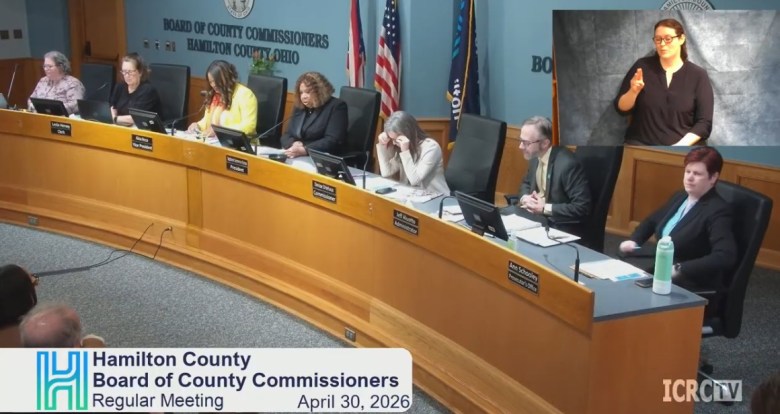
The public board room is a small, rectangular space with seating for roughly 30 to 40 audience members. The room is a warm combination of stately/official and welcoming. The commission conducts meetings from a low, D-shaped table at the front of the room. The table’s lower elevation puts the board members on eye level with the seat audience, creating the atmosphere that the board is there to serve, not rule over its constituents. To add to this atmosphere, the guest speaking podium was placed right in front of the president and the room sported two large screens for presentations and camera view of speakers. The board meeting was even accommodating for those who are hearing-impaired, as a live sign language translator was clearly visible in the upper right portion of the screen.
The board was seated upfront in the following order: Assistant Clerk Kristie Rachel (far left), Clerk Leslie Hervey (next left), Vice President Alicia Reece (left of center), President Stephanie Summerow Dumas (center), Commissioner Denise Driehaus (right of center), County Administrator Jeff Aluotto (next right) and Ann Schooley from the prosecutor’s office (far right).
Meeting Begins 10 a.m.
The first 10 to 20 minutes of the meeting consisted of the commission praising the hard and dedicated work of board Clerk Leslie Harvey, who is retiring this year. The audience was filled with Harvey’s coworkers (who attended to say goodbye) and family members, leading to members of the public standing against the walls or overflowing out into the nearby hallway. Harvey’s son thanked the board and commented on his mother’s joy working for them.
Harvey spoke highly of working for Hamilton County, recommending that others come to work for the county, saying it was “a great run for me,” filled with fun, and she hopes everyone keeps in touch. The room was overflowing with laughter, warmth, jokes and plenty of group photos.
Public Comments
Larry Falcon of the Sierra Club Miami Group (a local environmental/preservation group) addressed the board over issues with the Metropolitan Sewer District’s (MSD) implementation plan to address sewer overflow. He noted that the MSD’s plan is significantly off-course and makes the process slow, overly burdensome and very costly. He said the group had sent a detailed letter to every member of the board. While he was upset by the lack of response, Falcon also said he has a meeting with MSD set for May 13. He urged the board to meet with him to discuss the matter further.
David Barrens from Communities United For Action (CUFA) also addressed the board over MSD’s implementation plan. CUFA is opposed to an impervious-surface charge, stating that particular project is too slow, too complicated and too expensive. He cites a2022 study from Black & Veatch, commissioned by MSD, that found the fee was possible, and should apply to all rate tax-payers. Currently the plan only addresses 510 properties. Barrens said it is a waste of employee resources to generate only $500,000 a year.
Public Hearing
John Huth, senior planner with Hamilton County Planning and Development, presented a proposed zone change for Harrison Township. An allotment of land (18 acres) originally zoned as single family would be converted into a light industrial zone and subdivided into four parcels for development:
Section 1: RaceTrac fueling station
Section 2: Sitdown restaurant
Section 3: Fast food
Section 4: An industrial warehouse
Huth, the rural planning commission and the county planning commission recommended approval for the project as the development aligns with other development in the area. Huth said residents expressed concern over traffic issues and a desire to prevent a truck stop in the area. The township supported the project, Huth said.
An attorney representing RaceTrac addressed residents’ concerns by saying the developers are taking steps to mitigate impacts to the nearby residential neighborhood by retaining large trees and planting new trees in the areas to act as a buffer.
The attorney also said the area has already developed into a warehouse corridor, and the development would be in line with what is already there.
Commission President Stephanie Summerow Dumas called Huth back up to ask further about the traffic concerns. She expressed concern for the residents of the area. Huth said residents can remain in their properties and noted the residential area is already surrounded by industrial use zones. This development would be in line with what is already there, he added. He said the development will make remaining residential properties more valuable for future sale to developers.
Commission Vice President Alicia Reece further questioned how construction may impact traffic in the area and if the construction will impact access to churches or small businesses. She said she did not wish to impose undue burdens in an already tough economy. Huth said there aren’t any churches in the area and the impact on small business was not a zoning question, thus he could not speak to it.
He said the bridge will most likely remain open during construction (the bridge will be expanded from two lanes to five lanes to accommodate the increase in traffic) and there will be an increase in traffic.
Commissioner Denise Driehaus asked about the size of the property, who would own it, who currently lived in it, and whether the residents of the area supported the development. Huth said the property was 19 acres, and RaceTrac would own the property with the intent to lease or sell off the other three proposed sections of development.
Driehaus also asked what prompted the changes to the bridge and if it was meant to relieve traffic. Huth said it was expected to relieve traffic, and current conditions and future plans had prompted the change.
In response to another question from Driehaus, Huth also said there wasn’t any plan for further buffering of the area and that there was no timeline for the development of the other parcels.
Dumas called Huth back to the podium to express her concern for residents and her confusion over his conflicting statements on whether residents were on board with the project. Huth apologized and said he didn’t know when or if residents would be moving or continuing to live on the property. This prompted RaceTrac’s attorney to clarify that homeowners will be out by time of closing of sale and they will own the property.
Finally, Nancy Whitney spoke to the board. She said her house had been in the family for three generations and that the extra land on the property was being leased for farming. She said the increase of traffic in the area was making it difficult to access the property, and the interchange plan would be a plus. But, she expressed that she and the other residents (many of whom are elderly) had decided that it was “time to go.”
Dumas motioned to close the discussion at 10:57 a.m.
Regular Agenda
- Administrator Jeff Aluotto read Agenda Items 1 to 3.
- Items were presented by the engineer
- The expenses covered damages from landslides.
- All three items were passed.
Item 4: AMR Treatment at Mercy West Pump Station. MSD presented a proposal to add a project to the Capital Improvement Program. The project seeks to study and install a treatment system at the Mercy West pump. The goal of a localized treatment system is to monitor and prevent treatment-resistance strains of bacteria from entering MSD’s main treatment wastewater. It is easier to treat these strains closer to the source of contamination than to treat the whole system and potentially expose people to resistant strains of bacteria, Aluotto said.
Item 4 passes.
Consent agenda
Resolutions 5 through 15 were passed.
Comments and Questions about the Consent Agenda:
- Reece ordered a running spread sheet on all construction projects within Resolutions 5 through 15. She noted that Omega Sci-fi and the Cincinnati Music Festival are the biggest economic drivers of the year, bringing in a lot of tourism. In previous years, these events were hampered by construction. She requested something be put in writing that all construction will be paused during the weekends of these events and that someone must reach out to the Park Board to get the same assurance from them.
- Driehaus welcomed Assistant Clerk Rachel as the interim clerk and said she will do a great job.
- Reece expressed great happiness at having Rachel become the interim clerk and knows “she will keep everyone on task.”
- Dumas made comments about the renovations to the visiting team locker room at Paycor Stadium.
Wrap Up Remarks/Speeches:
- Reece reminded everyone early voting has begun. She also expressed her grief and hurt over the Supreme Court’s gutting/attack of the Voting Rights Act and Martin Luther King Jr.’s legacy
- Reece said there should be no taxation without representation. She expressed her dissatisfaction with the Hamilton County Landbank Development Project, noting that she has noticed that the majority of the land taken for the landbank was in majority Black communities and that the same was not happening to majority white communities like Hyde Park.. She said if they cannot include Black community members in the landbank development, then they do not need to be going into their neighborhoods. She said she finds the trend disturbing and wants to rectify the situation. The board will continue to speak up on the matter, she said.
- Driehaus praised the work done by Women Helping Women in Cincinnati. She said she got to participate in a Cincinnati Zoo event where students gave presentations on caring for watersheds, recycling and landfill cleanup.
- Driehaus also reminded everyone to check if their polling location had been changed as there has been a consolidation of polling locations within Hamilton County.
- Dumas attended the launching of the city’s first electric bus. She is part of a group that will be making recommendations for the dispersal of grants from the state.
Motion adjourned at 11:31 a.m.
If you believe anything in these notes is inaccurate, please email us at documenters@signalcincinnati.org with “Correction Request” in the subject line.
Find more Documenters’ notes here.