
Meeting summary:
- The Cincinnati Department of Planning and Engagement hosted a meeting to present and gather feedback on the first draft of the Madisonville Neighborhood Plan, set to be the first comprehensive plan for Madisonville.
- Longtime Madisonville residents are skeptical as to whether the Neighborhood Plan will address ongoing gentrification and protect low-income residents from displacement.
- Attendees shared feedback by placing stickers and notes on presentation boards. Working groups corresponding to the six “mission areas” that categorize the plan’s priorities will reconvene to integrate feedback from the meeting into a revised draft of the Madisonville Neighborhood Plan.
Documenter’s follow-up question:
- In the action plan, why is Habitat for Humanity identified as the funding source for building tiny homes and auxiliary dwelling units (ADUs) when Habitat for Humanity has previously stated that ADUs do not fit their model? Are there other possible oversights in the draft plan?
- How will planners from the City of Cincinnati and consultant firm McBride Dale Clarion respond to feedback to gain the trust of frustrated residents who spoke on gentrification concerns?
Notes
Overview
The first draft of the Madisonville Neighborhood Plan, set to be the neighborhood’s first comprehensive plan, is now available. According to the city website, “a neighborhood plan is a legal document adopted by City Council that sets the aspirations, vision, goals, and strategies for the long-term physical, social, and economic development of the neighborhood.” The city is leading the creation of the plan with support from local planning and zoning consulting firm McBride Dale Clarion.
Madisonville residents, business owners and other stakeholders convened Wednesday, April 29, at the Madisonville Recreation Center for a public meeting intended to gather feedback on the draft document. About 60 people attended.
The meeting began at 6:13 p.m. with a presentation explaining the purpose, structure and process of the Neighborhood Plan. The presentation was led by Andrew Halt, senior city planner with the Cincinnati Department of City Planning and Engagement and project manager for the Madisonville Neighborhood Plan; and Andy Juengling, senior planner with McBride Dale Clarion.
After the presentation, attendees were invited to place notes with comments on poster boards that showed the draft mission statements and planning strategies.
The opening presentation included an overview of the timeline for creating the Madisonville Neighborhood Plan, a walkthrough of the draft document, and a summary of the six “mission areas” that categorized potential action items and strategies to direct the future of Madisonville.
The presenters said the draft is a working document being shared for the purpose of public critique. They encouraged Madisonville residents and business owners to take ownership of the Neighborhood Plan.
Tensions boiled during the subsequent question-and-answer period as frustrated residents pressed the presenters about gentrification and the displacement of Black Madisonville residents.
Plan Process and Timeline
Early Community Engagement
Work on the Madisonville Neighborhood Plan began in January 2025 in response to a request that originated from Madisonville Community Council.
The planners convened an engagement committee of 15 people, including “residents, business owners, and others who just care about Madisonville,” to figure out how to engage the community, Halt said.
Early engagement asked residents “what they love about Madisonville and what they hope for the future of Madisonville,” Halt said. Members of the engagement committee received “Meeting in a Box” kits that allowed them to “bring the meeting” to their families and friends. The planners conducted similar community engagement at Tuesdays in the Park last June. The Madisonville Branch Library also served as an “engagement hub” with activities available for the public to submit ideas.
These forms of engagement were meant to “meet people where they were,” Halt said. In total, the “Meetings in a Box,” engagement hub, and surveys collected more than 300 responses, which Halt said was on par with other neighborhood planning initiatives.
Working Groups Brainstorm Actions for Priority Mission Areas
In fall 2025, planners compiled early feedback to identify six “mission areas” intended to reflect community priorities in Madisonville and to provide a framework for identifying actionable steps. The mission areas for the current draft of the plan are:
- Quality Housing for All
- Thriving Neighborhood Businesses
- Growing Greener & Healthier
- Creating Connections
- Supporting Youth & Education
- Showcasing Our History
About 40 people attended a community engagement meeting to discuss and revise the mission areas, Halt said, as well as an online survey.
For each mission area, the planners convened a working group of Madisonville residents, business owners and stakeholders to discuss actionable steps. (When asked after the meeting who authored the specific language, Halt said each working group had a designated scribe and planners used their notes to write the draft.)
Planners invited representatives from 20 organizations in and around Cincinnati, including the Cincinnati Parks department, the Department of Transportation and Engineering, and the Urban League, to an “Action Check-Up” meeting to provide feedback on what is actionable and reasonable, Halt said, “because one of our big goals of this plan is to make this the most actionable plan the city has seen.”
Halt conducted “stakeholder interviews” over lunch and coffee for one-on-one conversations. The planners also presented at Madisonville Community Council last year.
From December 2025 through January of this year, the planners composed the first draft of the Neighborhood Plan as presented.
Upcoming Meetings and Timeline
The goal of the April 29 meeting was to “finalize our actions and tasks as part of these mission areas,” “talk about the future of land use,” and “identify some key projects” for capital investment, Halt said. The planners expect to revise and complete the draft within the next few months, then will bring the Neighborhood Plan to the Madisonville Community Council, Madisonville Business Chamber and the Madisonville Community Urban Redevelopment Corporation (MCURC).
After local approval, the Neighborhood Plan will move forward to the City Planning Commission and City Council for final approval.
Working groups will reconvene in May to review feedback from the present engagement meeting with the current draft, Halt said. An updated draft will be made public in June. The summer and fall will likely see the plan finalized and approved, but the timeline is adaptable according to community needs and readiness, Halt said.
“We’re going to make sure that we are going at a pace that you all are comfortable with, because this is, at the end of the day, your plan, and you’re going to be the ones to bring it forward and see it turn into reality,” Halt said.
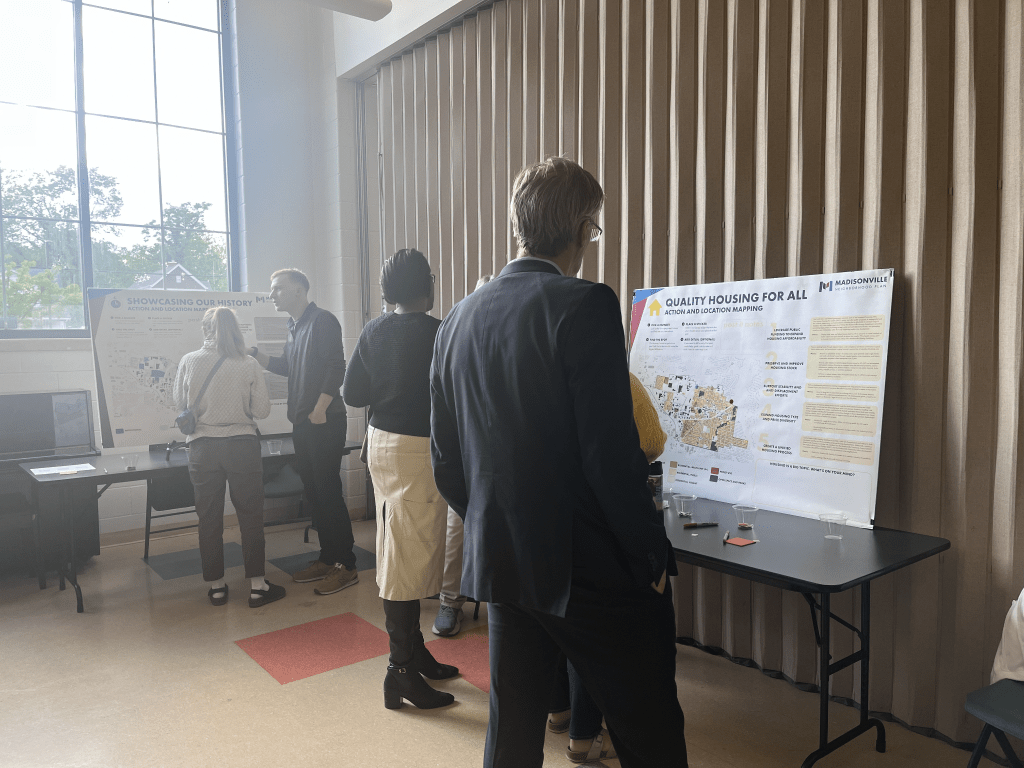
Meeting attendees perused the actions proposed in the draft Neighborhood Plan in an interactive open house format.
Plan Organization and Structure
Juengling, the planner, presented an overview of the draft. The document contains placeholders for photos and maps, and residents are invited to submit their own photos.
Opening Chapters
The draft of the Madisonville Neighborhood Plan begins with a summary of its purpose, framework, creation process and metrics. It includes definitions of the key terms the plan uses to designate different types of goal statements and proposals.
The second chapter provides a narrative introduction to Madisonville that tells the story of the planning process and lists past plans adopted for Madisonville in order to “recognize the work that has been done in the neighborhood in the past – good or bad – because it is part of the neighborhood’s history,” Juengling said. While past plans have been “targeted” for areas such as business districts or industrial areas, the in-progress Neighborhood Plan will be Madisonville’s first comprehensive plan.
The third chapter relays the history of the neighborhood, beginning with the Northwest Ordinance of 1787. The plan identifies cultural landmarks in Madisonville by name and photograph. Juengling encouraged residents to reach out with anything that they believe is missing from the chapter in order to compile “a good comprehensive history that is fair and representative of the neighborhood.”
Rather than “ignore” demographic changes, planners want to “bring them to light and understand how that’s influencing the feedback that we’re getting,” Juengling said. The fourth chapter summarizes existing conditions in Madisonville, including demographic changes over time, geography, physical conditions of the built environment, land use, zoning codes and development trends.
When complete, the fifth chapter, “Process & Engagement,” will describe findings from the community engagement phase of the planning process and how they informed the final plan.
The Action Plan
The Action Plan, the sixth and longest chapter of the draft Neighborhood Plan, outlines “the specific visions, priorities, and steps necessary to move from ideas to implementation,” according to the draft document. The Action Plan first describes each of the six mission areas and details the proposed actions within each mission area. For each action, the plan identifies metrics of success, potential funding sources, and the organizations or entities responsible for implementing the action.
- Quality Housing for All: Unlike other sections, the housing section includes a summary of national trends and a single implementation phase for all actions.
- Thriving Neighborhood Businesses: Action items concern improvements to areas with commercial activity, including sustaining current businesses and attracting new businesses “that support the existing residents of the neighborhood,” Juengling said.
- Growing Greener & Healthier: Proposals seek to improve access to fresh food and public green space, preserve the urban canopy, and beautify the neighborhood.
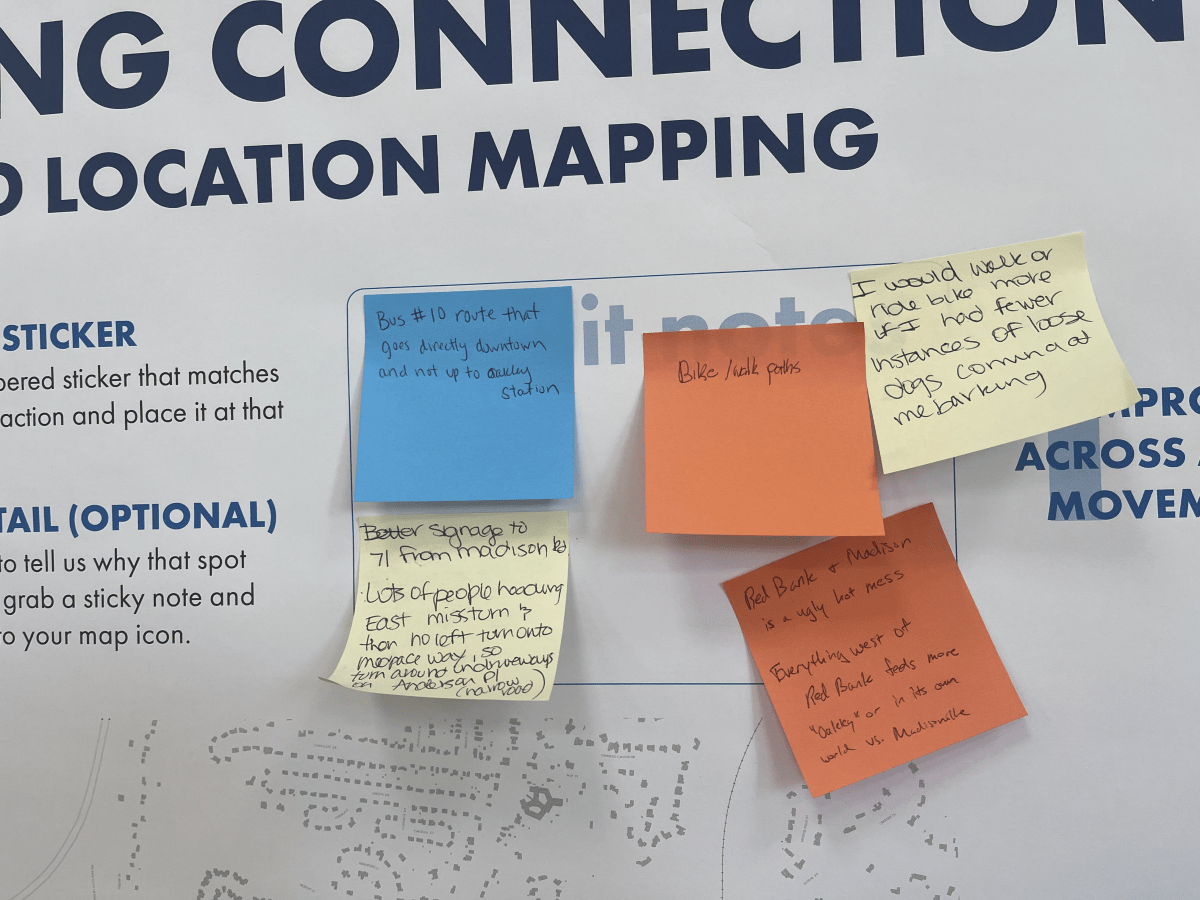
- Creating Connections: Transportation and walkability related action items include traffic calming, speed reductions and improving access to bus stops.
- Supporting Youth & Education: Providing “places for the youth to go” was “a big topic” across community engagement, Juengling said. Action items also include support for schools and families.
- Showcasing Our History: Action items seek to highlight and celebrate local history through storytelling, murals and care for historic sites.

The draft Neighborhood Plan groups proposed actions into six “mission areas,” represented across six interactive poster boards placed around the rooms. Attendees placed stickers with numbers corresponding to actions on a map of Madisonville to suggest where each action should be implemented.
Future Land Use & Capital Projects
Planners are “waiting until the end of the process” to complete the future land use map and capital improvement plan, Juengling said.
“Every city plan has a future land use map,” Juengling said, to reflect what types of buildings, whether residential or commercial, residents would like to see in specific locations. The future land use map will serve as a non-binding reference point for future policy decisions, such as zoning changes. Legislators will consider whether any future proposals to rezone land are consistent with the Neighborhood Plan or if there is ample reasoning to approve a conflicting proposal.
Next, the plan will list capital improvement projects that might have a high cost but “would make a big impact on the neighborhood” to identify priorities for allocating limited funding in the future, Juengling said. One of the night’s community engagement activities simulated budgeting decisions, as participants were asked to place six stickers on the project proposals they preferred out of nine options provided on a poster board.
When complete, the plan will list possible capital improvement projects with cost estimates, expected timelines, and the people or organizations that would likely be involved in implementation. Juengling said there would be time to review the final plan and voice concerns so “the plan that is the final draft is one that everyone has seen (and) is comfortable with.”

Attendees were invited to practice making budgeting decisions by placing six dots on their choice of nine proposals for capital projects.
Implementation
The implementation chapter names the parties that would be “most likely to implement” each action item and expected timelines. The purpose of the implementation chapter is to help the entities named decide how to prioritize funding and effort as their project capacity evolves.
Question and Answer
Several attendees who self-identified as longtime residents of Madisonville used the question-and-answer period to express frustration with gentrification that some said lowered their trust in the planning initiative.
Angela Pearson, corresponding secretary of Madisonville Community Council, asked the presenters for an estimate of what income a person would need to sustain in order to continue living in Madisonville. Pearson said residents with low and moderate incomes are at risk of being “pushed out” by the growth and development of higher-cost housing.
Another attendee, who identified as a 30-year resident and a former planner, echoed concerns about gentrification and said, “the attitudes have shifted” as many newer residents seem “entitled.” Further, residents need to go to other neighborhoods for shopping access, and the lack of space for youth has meant that “every child is (seen as) a problem child,” she said.
Halt and Juengling repeatedly responded “we hear you” and said they are still seeking feedback on the draft plan. Halt said the neighborhood plan would be “proactive” resident input, in contrast to the “adversarial” and “reactive” tone he has observed when residents speak to the city government at public meetings.
Public engagement and working groups have said that Madisonville needs support for existing residents rather than growth, Juengling said, including programs to improve existing homes and to fill the vacant storefronts with businesses accessible to current residents.
“It really sounds like gaslighting, with all due respect,” said one resident who stood up to speak and self-identified as a “legacy Madisonville resident” who resides elsewhere but owns property in Madisonville. She said people have approached her about buying her property for years, alleging the Neighborhood Plan would not stop private plans already in motion.
Attendees began to disperse through the room to read and engage with the poster boards as Halt continued to speak with frustrated residents in smaller groups.

Attendees were invited to practice making budgeting decisions by placing six dots on their choice of nine proposals for capital projects. One Post-It note suggested investing in a grocery store for Madisonville.Participants named the business areas that they use the most in Madisonville as part of an engagement activity for the mission area “Thriving Neighborhood Businesses.”

On the poster board dedicated to the “Creating Connections” mission area, participants identified what they would like to see change in Madisonville transportation.

Attendees placed Post-It notes on the poster board dedicated to “Quality Housing for All” to share their priorities and suggestions for the future of housing in Madisonville.
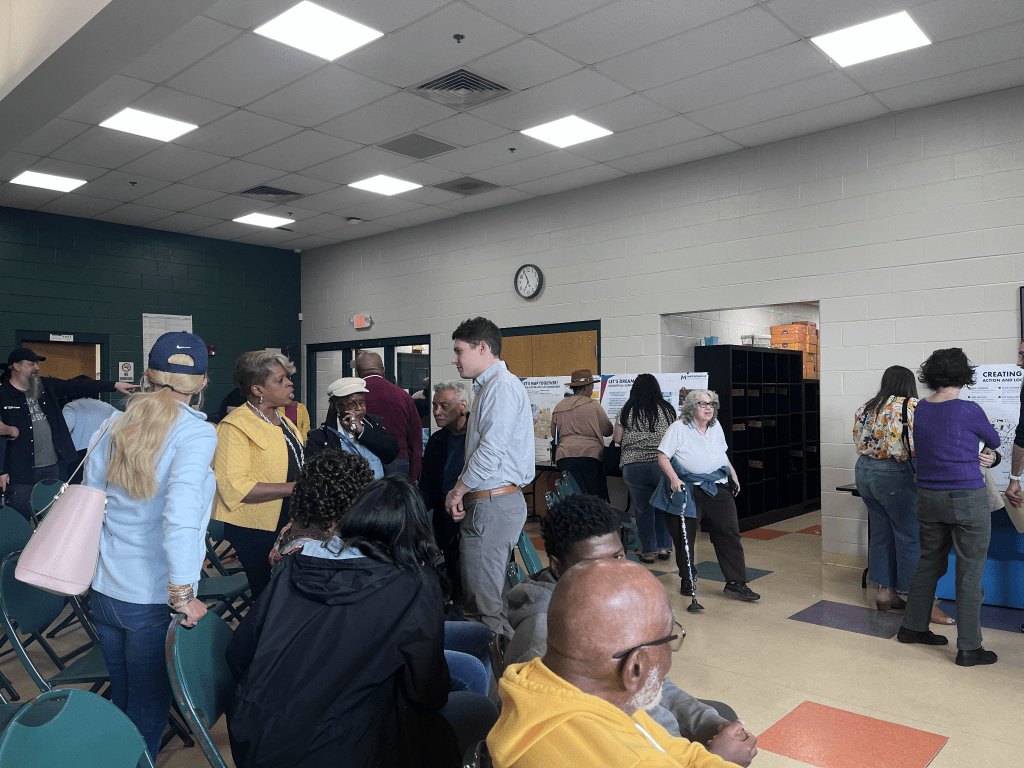
Andrew Halt, senior planner with the City of Cincinnati Department of City Planning and Engagement, converses with attendees who are concerned with recent development trends in Madisonville that many say are gentrifying the neighborhood.
If you believe anything in these notes is inaccurate, please email us at documenters@signalcincinnati.org with “Correction Request” in the subject line.
Find more Documenters’ notes here.