
Meeting summary:
- A “pipeline” created to streamline the building of affordable housing – and get projects done quickly – is working and needs to continue, the Cincinnati Development Fund’s chief strategist told a city council committee Tuesday.
Documenter’s follow-up question:
- How does the CDF address the stigma associated with trying to get affordable housing built?
- How does the CDF address the stigma around the perceived definitions of “affordable housing” vs. “low-income housing” vs. “market-rate housing”?
Notes
SCENE
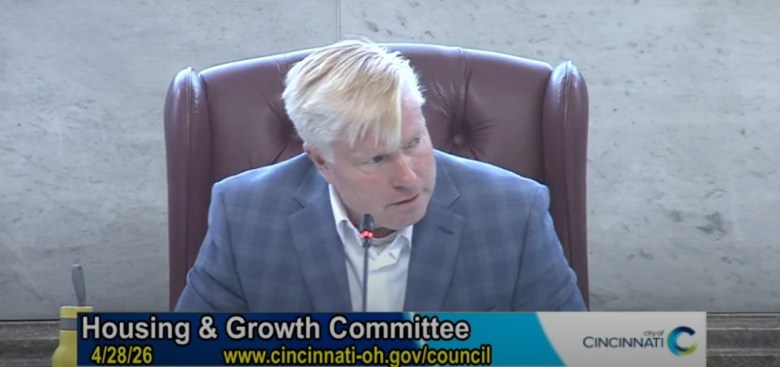
The April 28, 2026, meeting was held, as it is normally, in Room 300, Council Chambers, City Hall, 801 Plum St. in downtown Cincinnati. Committee Chair Mark Jeffreys called the meeting to order at 1:01 p.m. The committee adjourned at 2:23 p.m.
Committee Members
Mark Jeffreys, committee chair
Anna Albi, committee vice chair
Ryan James, council member
Evan Nolan, council member
Meeka Owens, council member
Seth Walsh, council member
Jeff Cramerding, council member
TIME SPENT
3 minutes: Public comment
73 minutes: (Update) Cincinnati Development Fund Annual Impact on Affordable Housing
2 minutes: Requested report on 2023 residential tax abatement reform
2 minutes: Emergency ordinance regarding lease with Findlay Ops LLC
1 minute: Ordinance regarding lease with Corryville Community Development Corp.
1 minute: Ordinance regarding lease with Oskamp Flats in downtown Cincinnati
PRESENTATIONS
Cincinnati Development Fund Annual Impact:
“An affordable housing delivery system. That’s really what this is,” said Luke Blocher, Cincinnati Development Fund (CDF) chief strategy officer and general counsel, in describing the “pipeline” the organization has created to forge collaborative partnerships between developers, builders and lenders to create affordable housing.
“You have to have a delivery system to get the outcomes,” Blocher told the Cincinnati City Council Housing & Growth Committee on Tuesday.
He and Joe Huber, CDF CEO & president, presented those outcomes in their annual update of CDF impacts. Today’s report covers the fiscal year April 1, 2025, through March 31, 2026.
During that time, CDF:
· Created 40 projects in 28 city neighborhoods
· Closed 53 loans
· Lent $46.6 million
· Won a record $70 million new markets tax credit award
· Continued efforts to strengthen the Cincinnati Energy Fund (Green Bank)
CDF is a mission-driven, non-traditional lending partner, not a bank. CDF, now more than three decades old, works with smaller developers, nonprofits and governments to create access to capital for mixed-use developments and multi-family housing.
The Affordable Housing Leverage Fund is a key component of the pipeline. In the 2025-26 fiscal year, CDF created 948 income-restricted units (640 are in the city throughout 24 neighborhoods, and 308 outside the city). Most of the units – 560 – are at 51% to 60% of Area Median Income (AMI). Blocher said 84% of AHLF units are at or below 60% of AMI. Multiple funding sources make the AHLF work.
“We’re not where we want to be,” Blocher said, “We want to do more. But this is a meaningful difference from where it was before this program [started two years ago] … and a consistent difference.”
He said if they continue the program in the same way, they can continue to deliver those results, and grow it with more resources.
The success of 2026 is a continuation of what has been happening since 2022, he said, in terms of loans written and approved. CDF’s success also has attracted five new private investors to the AHLF program, which must match city and county money with private investment as part of the pipeline. Some of the new investors include the KeyBank Foundation, the MassMutual Foundation and the Federal Home Loan Bank of Cincinnati.
“We’re at the leading edge of what’s happening in the nation” in terms of working to erase the hurdles to getting affordable housing built, Blocher said. “What we’re doing is working, and it is worth continuing to invest in.”
Council Member Mark Jeffreys agreed: “The CDF model is needed, and it is the right model.”
Inflation, materials costs, tariffs, interest rates and more present continuing challenges to building affordable housing.
“What we are engaged in collectively is responding to a national problem,” Blocher said, explaining that rather than having this one-off engagement between developers, builders and funders, the CDF pipeline brings everyone together.
“It’s not the natural order of things,” he said. “It does lead to much better impacts.”
Council Member Ryan James asked Blocher to explain, generally, how affordable housing gets built in Columbus. Blocher said the CDF pipeline is one process involving the lender, public subsidy, developer and builder, while Columbus operates a CDF-like pipeline that separates city funding from other funding streams.
Council Member Meeka Owens asked how the city and CDF can publicly show there is work being done and state and federal officials understand the importance of building affordable housing.
“Housing is maybe the last nonpartisan issue on the federal level,” Blocher said.
Owens asked how CDF can get affordable housing built more quickly.
“Quadruple down on the issue of coordination” and collaboration between developers, builders and lenders, Blocher said.
AGENDA
See Presentation above.
Item 2: Residential Tax Abatement Reform Impact Report (a motion)
The committee asked city administration for a report within 120 days regarding the impact of the 2023 Residential Tax Abatement Reform. Council has indicated its intent to review the program every three years. The motion submitted by Albi asks that the administration touch on several points in its report, including pinpointing the number and location of residential tax abatements approved since the 2023 reform, as well as a breakdown by housing type and whether the projects were new construction or rehabilitation.
Item 3: Findlay Ops LLC Lease Agreement
The committee sent this ordinance to council for passage. It allows City Manager Sheryl Long to lease the Findlay Market city-owned property at 1720 Race St., Over-the-Rhine, to Findlay Ops LLC for 55 years with optional renewals. Findlay Ops wants to lease the property to set up housing maintenance operations and to create or enhance the Findlay Market Shopping app.
Item 4. Corryville Community Development Corporation Lease
The committee sent to council for passage an ordinance allowing the city manager to lease city-owned properties at 10 W. Charlton St. and 12 W. Corry St. to the Corryville Community Development Corp. to maintain and operate public parking lots.
Item 5: Oskamp Flats Limited Partnership Lease
An ordinance authorizing the city manager to lease city-owned property called Egan Alley, downtown, to the Oskamp Flats Limited Partnership to remove trash and garbage from the alley and create a common area for residents who live in property adjacent to the alley.
The committee sent the ordinance to council for passage
The meeting adjourned at 2:23 p.m.
If you believe anything in these notes is inaccurate, please email us at documenters@signalcincinnati.org with “Correction Request” in the subject line.
Find more Documenters’ notes here.