
Meeting summary:
- In the wake of a video of a fight on Fourth Street, the Downtown Residents’ Council called a special meeting to discuss what the city is doing to respond to crime.
- The Cincinnati Police Department is aiming to further increase police presence downtown as it implements a drone program and street crime task force.
Documenter’s follow-up question:
- Do downtown residents have privacy concerns about crime prevention measures such as the drone program?
- Instead of a street crime task force, has the city considered other non-police, street-level social services for intervention? Police departments in Baltimore and in the Philadelphia area have recently made news for their successes in such programs.
FScene
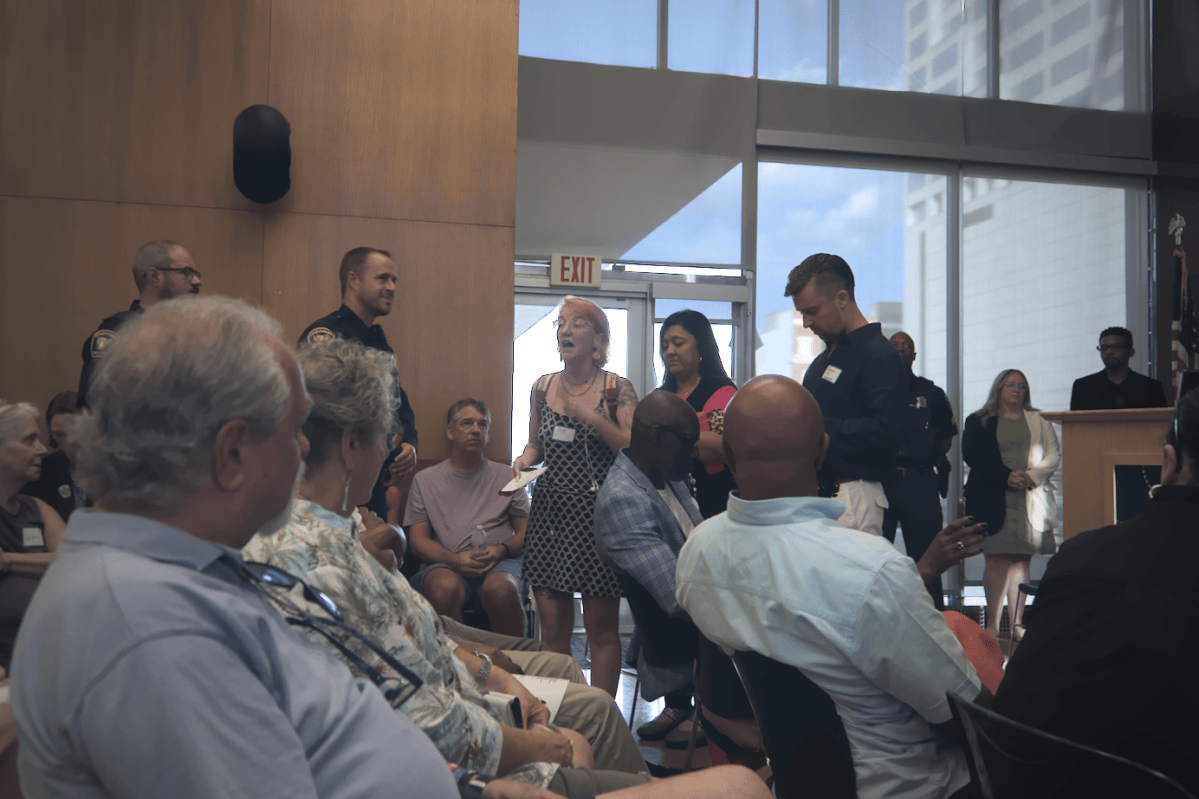
The Downtown Residents’ Council (DRC) meeting was held at the Cincinnati Public Library on Tuesday, July 29, at 6 p.m. and led by DRC Board of Trustees President Andrew Naab
Panelists:
- Police Chief Teresa Theetge
- Cincinnati City Center Development Corp. (3CDC) CEO Steve Leeper
- City Manager Sheryl Long
This Documenter was unable to get a full headcount but estimates more than 100 people were in the room. More people were standing than sitting because there weren’t enough chairs to accommodate the crowd.
Notes
Just before the meeting began, a man from the back repeatedly yelled into the room that City Manager Sherly Long should be fired. He was escorted out and Andrew Naab called the meeting to order at 6:01 p.m.
Naab told attendees the panelists would answer their questions. Some were prewritten, and more could be submitted throughout the meeting.
Anyone at the meeting could fill out a question card; however, questions from “downtown residents and stakeholders” would be prioritized, Naab said.
Long presented the ACT For Cincy plan. The plan outlines the city’s violence prevention strategies, particularly for gun violence and for engaging youth.
“We’re in an environment where everyone has a gun. It’s easier to get a gun than it is for some kids to go to a movie theater,” Long said.
You can find all the details in the ACT For Cincy blueprint.
Police chief gives crime update
About 30 minutes into the meeting, Police Chief Teresa Theetge presented crime data within the Central Business Section, updated July 28.

Of the viral video: “That was a violent, violent encounter. It makes me sick to watch it over and over again, in national news especially,” Theetge said. “I don’t like Cincinnati being portrayed in a negative light. We can do better – so much better.”
Theetge added, to the applause of meeting attendees, that there is no room for politics in law enforcement.
As of Tuesday, five people had been identified as suspects. Of those, two were in custody and another was negotiating a surrender.
You can read more about the youth curfew concept here. Council members will decide how to implement a plan when they return to session in August.
She also discussed a new drone program that addresses street-level crimes. A street crime task force is also on patrol, and the department is recruiting officers to assist in these efforts.
The Cincinnati Police Department (CPD) is working to gain more recruits: A 58-member police academy class is underway. A lateral police class – a training class composed of officers already trained by other departments – is expected to begin Jan. 26.
Panel
About 56 minutes into the meeting, the three-member panel was about to start accepting questions when another protest broke out in the room. A woman, whom officials identified as “Ally” (spelling unclear), rushed the podium as the first question was read aloud.
“Who are you protecting? Who are we serving? Why is it violence when it’s against the people of the city and nonviolence when it’s against Black and brown people of the city? … “F*** ICE, free Palestine”
The woman was escorted out.
Question: What can be done to hold parents accountable for kids left out after curfew?
Theetge said parents need to show accountability: “If you mess up, if you misbehave, you’ve got a price to pay.”
“I don’t think that is too much to ask of every parent in this city. Know where your kid is, what they’re doing and who they’re with,” she said. Know what they’re doing in and out of the house. What are they doing on social media, for example?
Long said the city is providing children and teen programming at a decent hour, and officials are collecting data to measure impact.
Police are working with schools, courts and prosecutors on how to move forward.
Question: What is 3CDC’s ambassador program?
Leeper said 3CDC employs 42 ambassadors downtown, supplying 24/7 coverage.
They clean garbage, engage with folks, escort customers to cars, give them directions – and take on “matters that often put them in harm’s way.”
Their public safety value? “They are our eyes and ears on the streets,” Leeper said.
Question: What is being done about nuisance businesses with liquor license and firearm violations?
Theetge said neighborhood officers are familiar with issues surrounding establishments and will note for future investigations.
“If we know we have a problem bar, we have to start documenting, documenting, documenting,” Theetge
Long said people should call 311, the city’s nonemergency line, with any reports of private establishments violating the law.
Question: What resources are available to police officers for mental health and morale?
Theetge said the department started offering more mental health resources for officers about eight years ago when a sergeant took his own life while working.
- CPD now has an officer wellness program with a mental health specialist and therapy dog.
- Officers and their families also use the Cortigo app and take a self-assessment, which connects them with specialists who can respond when an officer just witnessed a critical incident.
- City employees also have access to an assistance program for mental health services.
Question: What is the public safety strategy at The Banks?
Theetge said there are “many levels” to the public safety strategy at The Banks bar and entertainment district. Police presence has risen in the downtown areas overall, and the Central Business District (which includes The Banks) has its own police section. A police unit is dedicated to parking enforcement and getting cars towed.
Only those 21 and older can enter the “restricted area” in the Designated Outdoor Refreshment Area (DORA):
“We noticed a lot of children going into areas where they shouldn’t be,” Long said. “Grown people want to have fun, but there are places where children should not be.”
Also regarding youth curfews, the city is aiming to restrict park hours to those 17 and younger.
Question: What are we doing for equitable growth in OTR and the Central Business District?
Leeper said it is “pretty obvious” what the city is doing to equitably grow downtown areas such as Over-the-Rhine and the Central Business District. He said the solution is continuing to invest in those areas.
He gave a breakdown of efforts:
- There has been about $2 billion in development downtown in the past 20 years.
- In OTR, there have been 450 affordable housing developments.
- $42 million invested into homeless facilities.
- 3CDC worked with the city to devise programming “focused on diversity” at Ziegler Park. There are currently 600 children taking swim classes there, and free summer camp is also offered.
Question: Will materials available tonight be available and disseminated to DRC members?
Naab said yes, materials will be disseminated to DRC members.
This was the last question; Naab said there were many more questions that could not be answered.
Members of the DRC Public Safety Committee made brief remarks about forming that board some months back. They are looking for volunteers to help and bring forward ideas.
The meeting was adjourned at 7:32 p.m.
You can find these notes on Documenters.org
If you believe anything in these notes is inaccurate, please email us at documenters@signalcincinnati.org with “Correction Request” in the subject line.
Find more Documenters’ notes on Cincinnati City Council here.