
Meeting summary:
- Food insecurity, housing instability and health inequity are all related to the shortage of affordable housing in Cincinnati. These conclusions are based on local nonprofits’ data tracking requests for assistance from Cincinnati zip codes in 2025.
- Housing and food insecurity are worsening in Cincinnati. Nonprofits that provide support for basic needs and eviction prevention are requesting additional public funding to meet record-high demand for services.
- Representatives from Cincinnati nonprofits urged City Council to take action to meet the need for affordable housing in Cincinnati, particularly for households earning 30% area median income (AMI) or less.
Documenter’s follow-up question:
- Is there data available to estimate the return on investment for publicly funding the development of affordable housing for households earning 30% AMI or less relative to the cost of providing the food, medical, and legal supports discussed to rent-burdened households?
- Why did spending on the New Americans Project increase so drastically in 2025? Has the federal immigration crackdown put a greater number of immigrant families in Cincinnati at risk of homelessness?
Notes
Call to Order
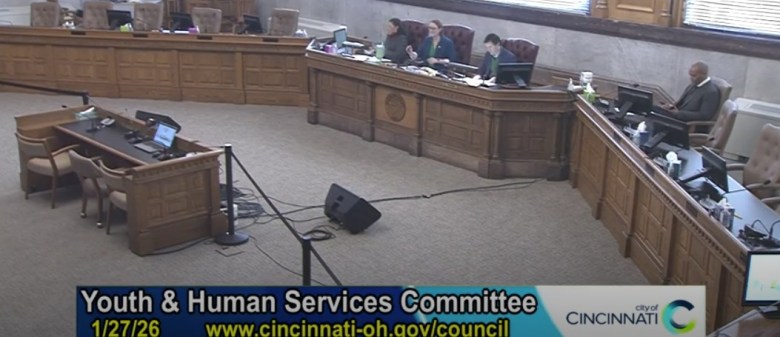
The Jan. 27, 2026 meeting of the City Council Youth and Human Services committee featured presentations from three different organizations all working in the sphere of addressing food insecurity and homelessness prevention, said Council Member Anna Albi, who is chair of the Youth and Human Services committee, said.
Representatives from Freestore Foodbank, St. Vincent de Paul and United Way reported a surge in requests for assistance with basic needs in the past year. Cincinnati’s housing affordability crisis is a common cause for the distress, according to data from each organization.
Albi called the meeting to order at 12:32 p.m. with the following in attendance:
City council members:
- Anna Albi (committee chair)
- Evan Nolan (committee vice chair)
- Vice Mayor Jan-Michele Kearney (committee member)
- Ryan James (committee member)
Presenters:
Freestore Foodbank:
- Angela King, director of social services
- Valarie Boykins, vice president of human resources organization development
- Lindsay Starry, director of annual fundraising operations
St. Vincent de Paul:
- Kaytlynd Lainhart, vice president of external relations
United Way:
- Matt Long, impact program management director
- Nick DiNardo, attorney at law, Legal Aid Society of Greater Cincinnati
Committee Member Jeff Cramerding arrived later, around 1:30 p.m., during the third presentation.
Item 1: Freestore Foodbank Presentation (begins at timestamp 3:13)
Presenting on behalf of the Freestore Foodbank, Angela King, Valarie Boykins, and Lindsay Starry said demand for their services has skyrocketed, causing a drastic increase in Freestore expenditures.
The lapse in SNAP benefits during November’s government shutdown was one expensive challenge for the Freestore, but King emphasized that food insecurity intersects with other affordability crises, such as housing. The Freestore also needs more funding for its wraparound services meant to meet those intersecting needs.
The Stabilization Program, which assists individuals who are working or in job training, is one of several that has seen a big jump in expenditures since last year, King said. The Shelter Diversion program, which helps people in unstable housing situations to avoid street homelessness, incurred triple the expenses in its most recent quarter than the same period last year. (See Agenda Packet for detailed expenditure reports.)
“I challenge City Council and others to say, help us meet the need around housing insecurity,” King said.
The Freestore’s New Americans Project assists immigrant and refugee families who are at risk of homelessness. In the first quarter of FY-26, the program cost $35,569, compared to only $1,911 in the same period the previous year. Funding for the program ended in October, “but we have a way to put them in our stabilization programs so that we can continue services,” King said. The New Americans Project stopped accepting new referrals in August 2025.
Food insecurity is at a 10-year high and continuing to worsen, Starry said, based on data from Feeding America.
The Freestore is also spending significantly more to purchase food that was once donated, Starry said, as companies have reduced their food donations in the past few years. Uncertainty and delays around federal funding over the summer also contributed to the Freestore’s increased expenditures on food.
The federal One Big Beautiful Bill Act, which President Trump signed in July, sets new requirements for families to receive SNAP benefits. Boykins said the changes have the potential to negatively impact families, but there is not yet data to assess the impact on Freestore demand.
James said that his team is working to research and understand the cause of soaring utility bills in Cincinnati. He said the average utility bill in Cincinnati has gone up about 70%, but the source and timeframe for the statistic were unclear.
James asked how residents qualify for utility assistance. King said the Freestore follows guidelines set by the Ohio Department of Job and Family Services, allowing up to $2,500 grace.
Individuals can “get kicked out” of programs that adhere strictly to the eligibility guidelines following income increases as modest as picking up an extra shift, King said.
“That’s something that does need to really change,” Kearney said. “Because that penalizes people for working.”
Item 2: The Intersection of Housing Instability and Food Insecurity in Cincinnati (begins at timestamp 28:00)
Kaytlynd Lainhart, vice president of external relations at St. Vincent de Paul (SVDP), called for improved collaboration with the city and among nonprofits to address the common causes of food, housing and health equity crises in Cincinnati. Lainhart said that SVDP focuses on food, medicine, and shelter, and is seeking a long-term roadmap to stability rather than “band-aid” solutions. Last October, SVDP saw record high numbers in requests for assistance.
“Food is feeling like a symptom of the greater housing issue,” Lainhart said, based on a study of zip codes that have received rent, utility, and food assistance.
Lainhart said that the city should approach food, housing, and medicine as intersecting issues that are all part of homelessness prevention rather than “separate safety nets,”
SVDP is seeking $5 million from the City of Cincinnati through a multi-year partnership.
Albi asked what SVDP’s approach looks like to assist a typical family. Lainhart said that often, when an individual or family approaches SVDP about a single form of support, the organization will diagnose additional needs. For example, a person seeking rent assistance might have stopped taking their medication due to cost.
Nolan asked for clarification on why requests for medications reached a record high in October.
Last year, SVDP saw an 8% increase in prescriptions dispensed, but a 16% increase in the volume of patients, Lainhart said, adding later that they are trying to make sure that people have the right medications and that they’re also getting healthier. This outcomes-based approach includes calling recipients of medication to follow up on their results.
SVDP receives some referrals from the emergency room for patients who are uninsured or underinsured. Lainhart said their free medication program is “a rare service to offer.”
“The social determinants of health are key to how we operate at St. Vincent de Paul,” Lainhart said.
Item 3: Building a Coordinated Eviction-Prevention System (begins at timestamp 14:50 on second recording)
Matt Long, impact program management director for United Way, and Nick DiNardo, an attorney with the Legal Aid Society of Greater Cincinnati, presented on the importance of access to legal counsel to prevent evictions.
The United Way 211 hotline is open 24 hours to connect callers to resources for basic needs, housing and utility assistance, mental health services, and employment services. The United Way is also implementing a new tool called Care Suite to connect people to resources, including legal counsel to avoid eviction.
Long said that the improved platform allows United Way “to connect families in a matter of moments instead of days.” When it comes to preventing eviction, Long said minutes matter. DiNardo later said that eviction cases move extremely quickly, lasting about 30 days from start to finish.
United Way uses Care Suite to collect real-time data to understand local need and organizational capacity. That data has reaffirmed that housing security remains a top need in the City of Cincinnati, Long said, In 2025, over half of the 19,000 calls related to housing were asking for rent assistance.
The Access to Counsel program, a collaboration of United Way, the Hamilton County Clerk of Courts Help Center, and the Legal Aid Society, spent about $1.2 million in 2025 to provide legal counsel to nearly 700 families facing eviction.
The program has grown in the two years since receiving its first investment from the City of Cincinnati, Long said. Access to Counsel has a new partnership with Housing Opportunities Made Equal (HOME) to provide pre-litigation mediation services that Long said would grow the number of people served, requiring additional funding. Long said that the United Way estimates that, with an additional $200,000 investment, could help more than 100 additional families.
Last year, the city funded an assessment of the impact of the Stabilization Through Eviction Prevention (STEP) program. Long noted the study’s finding that “every dollar that is invested” in legal representation and rent assistance has a return on investment of about $2 to $4 of savings in the social service and public service sectors.
Long cited an additional study from the University of Chicago that found a correlation between eviction rates and gun violence. He said that legislators in Philadelphia have considered eviction prevention measures as a way to reduce gun violence.
Nolan, who has experience providing legal aid through the Help Center, said that eviction prevention sometimes looks like rental assistance for a one-time emergency, but in other cases, “that rent is just not sustainable moving forward.” In these cases, legal assistance often meant settling with the landlord to prevent the tenant from having an eviction on their record.
“But it’s never really been clear to me what happens next,” Nolan said. “They’ve handed over the keys, they’ve moved out, but where do they go? And how do we support those folks?”
“When it comes to individuals in our region who are 30% AMI (area median income) or lower, there are only 41 units available for every 100 people,” Long said, citing Results for America. “So really what this comes back to, Council Member Nolan, is I think our duty and our job is to continue advocating, in a lot of different spaces, continue advocating for the development of more affordable units.”
Long said that the city should also consider what jobs are available, noting that the average wage in Cincinnati is not enough to afford the typical rent in Cincinnati.
Long hopes that this reality becomes “reason for us to all stand together with one voice to advocate for serious changes, and for more development, and for changes to our wages.”
Last October, housing activists demonstrated in front of City Hall and gave public comments to demand mandatory inclusion of affordable housing for households making 30% AMI or less in new developments, among other amendments to Connected Communities.
“It’s crazy how much we can accomplish with a $1 investment at the right time,” Albi said.
Closing (timestamp 42:45)
Committee members closed the meeting with statements on the ongoing immigration crackdown and violence at the hands of Immigration and Customs Enforcement (ICE).
“We really see our immigrant community as vital to the vibrancy of our city. These are our residents, these are our neighbors,” Albi said.
Earlier this month, City Council passed a resolution denouncing the fatal shooting of Renee Nicole Good in Minneapolis and urged any “federal law enforcement operating in Cincinnati to comply with City policy and operational requirements related to masks, body cameras, and officer identification.”
“The city of Cincinnati, the Cincinnati Police Department, does not assist with federal immigration enforcement. Our Cincinnati Police Department does not ask about immigration status when working with our community,” Albi said.
Responding to “folks who have challenged us,” James said the council’s work to support the immigrant community “is just getting started,” despite the fact that their hands are tied with some federal legislation.
James commended the public services team, some of whom worked in 12- to 24-hour shifts over the weekend, to respond to the heavy snowfall.
The meeting adjourned at 1:55 p.m.
If you believe anything in these notes is inaccurate, please email us at documenters@signalcincinnati.org with “Correction Request” in the subject line.
Find more Documenters’ notes here.