
Meeting summary:
- Activists demonstrated in front of City Hall to demand amendments to Connected Communities, such as mandated inclusion of affordable housing for households making 30% AMI or less in new developments.
- Following nearly an hour of public comment, the City Council came to order for a meeting lasting less than four minutes.
Documenter’s follow-up question:
- Now that the task force to amend Connected Communities has presented findings, what are the next steps for turning the recommendations into legislation?
- Connected Communities took effect in July 2024; considering that most development projects take several years, how long will it be before there is data to assess how the legislation impacts housing availability and affordability in Cincinnati?
Housing Demonstration
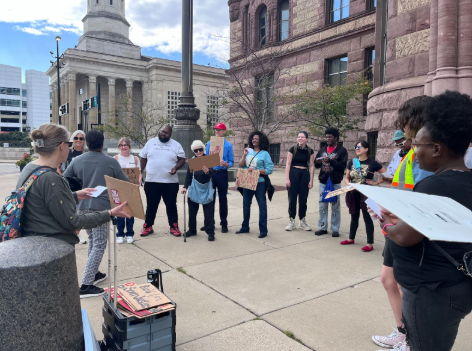
Prior to City Council’s Oct. 15 meeting, housing activists from the Greater Cincinnati Homeless Coalition, Cincinnati Action for Housing Now (CAHN), Communities United for Action (CUFA), and others demonstrated outside of City Hall to demand amendments to last year’s Connected Communities legislation in order to meet Cincinnati’s need for “truly” affordable housing.
Speakers at the demonstration encouraged attendees to sign up for public comment before City Council to express the need for affordable housing in Cincinnati. Activists passed out flyers their demands, including a prohibition on “displacement of residents by developers receiving incentives,” the “mandatory inclusion” of units affordable to households earning 30% AMI and below in “all projects,” and other guidelines related to stormwater management, energy efficiency, and the empowerment of Community Councils to approve or deny “large new developments.”

Above: Activists distributed flyers as a guide for public comment.
Activists engaged in chants such as “serve the needy, not the greedy!” and “Hey, yo! Big greedy developers gotta go!”
Activists said that existing incentives allow for rental units accessible to individuals earning up to 80% of the area median income (AMI) to be considered “affordable housing,” which in Cincinnati equates to a family of four earning $89,450 annually. A household is considered rent burdened if the cost of rent exceeds 30% of the household income. This means affordable housing for a family of four earning 80% AMI would cost $2,236 or less per month. Demonstrators said such a threshold is still far out of reach for the majority of Cincinnati residents.
Addressing the group, Rico Blackman, an organizer for the Greater Cincinnati Homeless Coalition, expressed gratitude for some aspects of Connected Communities, but said the legislation did not do enough to address housing need.
“Don’t get me wrong, we do need to fix the zoning. Single-family zoning has destroyed our country. It has made it very hard to build multi-family homes. I grew up in an apartment complex and I’m very thankful I did … yet it is very hard to build something like that nowadays. So, we give Connected Communities the A-OK on that,” Blackman said. “But when it comes to displacement, when it comes to affordable housing, Connected Communities does s–t. It doesn’t do anything that will help our community except give developers more money. Is that right?”
Demonstrators responded in unison, “That ain’t right!”
David Reeves, chief of staff for Council Member Meeka Owens, came out of City Hall to address the demonstrators, defending the current council’s record for incentivizing affordable housing. He distributed a packet (see attachment, “Cincinnati Tenants’ Guide scan”) of landlord and tenant rights and responsibilities to demonstration attendees.
Council members Kearney, Johnson, and Parks recently led a task force to recommend amendments to Connected Communities, in which some of those demonstrating had taken part.

Above: Activists gather in front of City Hall to demand mandatory inclusion of affordable housing, among other amendments to Connected Communities.
Public Comment
Twenty-nine people gave public comments in person and over Zoom, stretching the public comment period to an hour. This is double the time typically allotted. Over half of commenters spoke on housing need and affordability in Cincinnati. Other topics included concerns about crime, the Palestinian genocide, and local government transparency.
The following is a selection of quotes given as public comment:
“Policing is a band-aid, it is not getting to the root cause of what our community needs, which is basic housing … We are all one check engine light, one eviction away from homelessness.” (Trudy Gaba)
“I was a member of the affordable housing working group, and I know that we shared research that shows mandatory inclusion of affordable housing works. It’s been shown in a lot of cities, including those like Pittsburgh, Detroit, Atlanta and Minneapolis. Minneapolis is shown as an example for Connected Communities for its upzoning policy. Yet Minneapolis had to amend their own housing for mandatory inclusion because they were seeing that affordable housing was not (getting built])” (John Calhoun, organizer with CAHN)
“My husband is a third grade teacher in Covington Independent Schools. We get a lot of displaced students from Cincinnati Public Schools because unhoused students are often traumatized from unmet needs and displacement, and (have) severe behavior issues, and so they get expelled from schools.” (Jessie Heizer)
“I am a 74-year-old grandmother who now has a 9-year-old grandchild and we are homeless … I tried to find places and for a one-bedroom, it’s like almost $1,500. For a two-bedroom, it is $1,600 and above. My pension will not afford that.” (Helen Louise Berver)
“More so than just Connected Communities, the city needs to prioritize reinvesting in the community directly, via subsidizing health care costs if possible, and other such ways to put money and tax dollars back into our communities, into the people themselves to revitalize, not to the police or anything that (inaudible) to put people down.” (Patrick Summers)
“Over this last week, a ceasefire deal was signed in Gaza … And we here were told that peace has been achieved. That peace is when Israeli forces burn homes and food in sick celebration. That peace is when Israel can continue killing and kidnapping … Every week we come here. We don’t tell you that crime is being committed in Palestine because we think you alone will go and stop it. We tell you with the expectation that you will function on basic morality and understand that anyone partaking in these crimes is not serving the city’s business or investment … The Democratic Party, yourselves included, has been absent in the fight for peace against its greatest assailant, genocide.” (Jonathan Nortmann)
“I thought a college degree and years in employment would keep me secure, not rich, but secure, in retirement and old age. Nope. Rising inflation, higher property taxes and astronomical drug prices, coupled with cuts to Medicare and Medicaid, may bankrupt or kill me.” (Lenore Newland)
“Everybody wants to know why affordable housing is so important … It’s one of our foundations for building a strong community.” (Nico, Black Power Initiative)
“I hope that the crime does go down, but let’s be real. Our community is in need of a lot of things, and one thing in particular that we need is more truly affordable housing . . . They should not be having to open up a safe lot when we have the funding to build housing for all the kids who will be sleeping in the safe lot next year starting in March. We have enough funding to house all the people who live in the streets today. We have data that shows crime reduces when you get people into homes.” (Rico Blackwell, director of organizing for Greater Cincinnati Homeless Coalition)
Call to Order
After public comment, Mayor Aftab Pureval called the meeting to order at 2:27 p.m. with the following in attendance:
- Mayor Aftab Pureval
- Vice Mayor Jan Michele-Kearney (council member)
- Anna Albi (council member)
- Mark Jeffreys (council member)
- Scotty Johnson (council member)
- Evan Nolan (council member)
- Meeka Owens (council member)
- Seth Walsh (council member)
- President Pro Tem Victoria Parks (council member)
- Nicole Crawford (chief deputy clerk of council)
- Anthony Covington (clerk of council-designate)
Council Member Jeff Cramerding was excused from the meeting.
Mayor Pureval moved agenda items 1 to 19 forward as indicated in the agenda packet without discussion.
Council unanimously passed item 20, “AUTHORIZING the City Manager to execute a Water Service Agreement with the City of Madeira, Ohio,” as an emergency ordinance.
The meeting adjourned at 2:31 p.m.
These notes can be found on documenters.org.
If you believe anything in these notes is inaccurate, please email us at documenters@signalcincinnati.org with “Correction Request” in the subject line.
Find more Documenters’ notes on Cincinnati City Council here.