
Meeting summary:
- Public commenters responded to a hearing on the recommended HThe Cincinnati Department of Public Services (DPS) is implementing new communications technology and drones to track weather conditions and snowplow progress. A lack of modern technology hindered the city’s response to Winter Storm Blair the week of Jan. 6, 2025, according to an internal Department of Public Services assessment.
- The DPS Fleet Division is seeking additional funding over the next six years to replace an extensive backlog of essential city vehicles, such as fire equipment and snow plows, that meet end-of-life criteria but remain in use.
- A public commenter said Cincinnati’s planned widening of Interstate 75 as part of the Brent Spence Bridge Project will harm residents and the environment while failing to modernize the city’s infrastructure.
Documenter’s follow-up question:
- To what extent does worn and outdated technology pose a safety risk to first responders and the public during emergency fire and rescue operations?
- Why did City Council vote to transfer $5.42 million from a fund reserved for weather emergencies to fund policing and crime deterrence while an assessment of recent weather response failures was in progress?
Notes
This meeting was documented via CitiCable asynchronously.
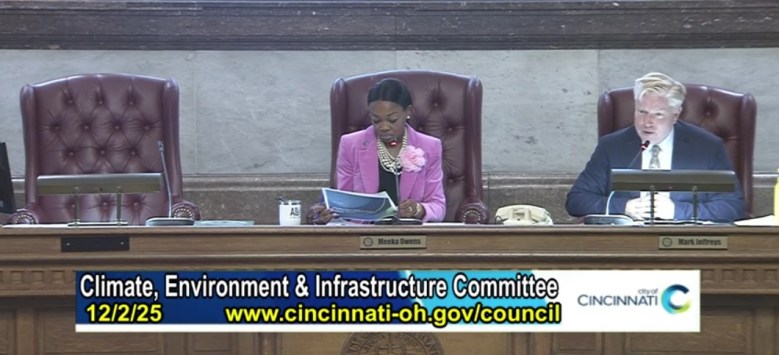
Meeka Owens, City Council member and Climate, Environment, and Infrastructure Committee chair, called the Dec. 2, 2025, meeting to order on the snowy Tuesday morning at 10:03 a.m. with the following in attendance.
Mark Jeffreys, committee vice chair and council members
Jeff Cramerdin, committee member and a council member
Ashley Pannell, Solicitor’s Office representative
Oliver Kroner,Office of Environment and Sustainability
Seth Walsh, also a member of the committee, arrived late. Owens welcomed Walsh to the meeting around the 27:10 timestamp on CityCable, though it is unclear when he arrived.
Public Comment (1:08 on CitiCable)
Bob Hyland, a University of Cincinnati professor speaking on his own behalf, said that the city of Cincinnati is “going back in time” by funding highway expansion projects – such as the planned widening of Interstate 75 as part of the Brent Spence Bridge Project – instead of investing in more sustainable public transportation alternatives.
Hyland compared Cincinnati to Belgrade, Serbia. Belgrade, Europe’s largest capital city without a subway system, has plans to build its first line by 2030, while Cincinnati will be “five years into a 10-year quagmire of highway expansion construction.” Hyland said Cincinnati’s infrastructure will lag decades behind Belgrade’s despite spending billions more.
“I am asking you to please set aside what feels politically expedient in this moment to stand up for the residents of the West End, Camp Washington and Queensgate, say no to inefficient fossil-fueled transportation infrastructure, and say yes to better transportation alternatives,” Hyland said.
According to FEMA, an environmental impact statement (EIS) is a detailed analysis and evaluation of all of the impacts of the proposed project and all reasonable alternatives.
Presentation: Department of Public Services on state of city fleet [3:53 on CitiCable; slides included in attached agenda packet]
Cincinnati Department of Public Services (DPS) Deputy Director Bower and Fleet Division Manager Liam Norton gave a presentation on the status of Cincinnati’s vehicle inventory. The fleet includes emergency and maintenance vehicles.
Norton said a vehicle is eligible to be replaced once it has met at least two of three criteria on age, mileage and life-to-date cost of maintenance. Vehicles in the Essential Fleet, those “required for the delivery of essential basic services” or “with a high frequency of use,” are prioritized for spending. Funding could come from City Council allocations or from grants.
The Fleet Division is working with the Office of Performance and Data Analytics (OPDA) to collect higher quality data on vehicle utilization to forecast replacement needs and eliminate low-usage vehicles.
In developing Cincinnati’s Fiscal Year-27 capital budget and beyond, including the Recommended Capital Improvement Program, an additional $5 million to $7 million will be needed annually to fund replacement of the essential fleet, according to Norton’s presentation.
The Fleet Division is also hoping to purchase a new Bergkamp SP5E spray injector pothole patcher vehicle. DPS Director Mark Riley later said the $375,000 vehicle would reduce road repair costs because it requires fewer operators than the city’s existing equipment. Norton said $700,000 has been allocated to purchase pothole patchers.
Discussion and Questions [CitiCable 16:10]
Bower said the division hopes improved data collection of expected use will help factor in lead times for making replacement vehicle purchases.
Bower said the Fleet Division has used FY-26 funding to purchase two pumpers and one ladder for fire trucks. Deliveries for this equipment are expected in October 2028 and April 2029.
Pending additional funding, Walsh asked for a projection on the timeline to address the city’s backlog on fleet.
Bower said funding would enable the department to address the need within the next six-year capital plan. The department must collect additional data.
Presentation: DPS winter operations program [40:07 on CitiCable; slides included in attached Agenda Packet]
Assistant City Manager Cathy Bailey and new DPS Director Mark Riley presented on winter operations.
Earlier this year, City Council asked the administration to provide a report evaluating the snow removal plan implemented during the week of Jan. 6, 2025, in response to Winter Storm Blair.
The last winter storm in Cincinnati comparable to Blair occurred nearly 17 years prior, Bailey said. In that approximate timeframe, Bailey said DPS has had six different directors, cut over 125 staff positions, and reduced its training budget. Vehicle replacement efforts stalled after 28 experienced employees retired.
According to the presentation:
- The week of Jan. 6, a lack of modern technology hindered snow response.
- Plow drivers used binders and paper maps along their routes and would call supervisors to report completion.
- Those supervisors often lacked mobile devices, such as laptops and tablets, because they were out of their offices to observe plow routes. This meant that they could not access or provide updated information until returning to their desks.
- As a result, up-to-date information came hours later.
Vehicles posed a number of challenges, Bailey said, as older and newer vehicles alike broke down as a result of intensive, continuous use.
Requests for service to respond to potholes and slippery, icy and snowy streets started before the storm beganBailey said. Requests accelerated in the days following the snowfall. It was very challenging for supervisors to keep up with closing individual requests while simultaneously continuing to clear streets, he said.
Recommendations to improve snow response include more experienced staff, a communications plan, a focus on filling vacant staff positions before October each year, issuing winter personal protective equipment to employees before winter, use of technology such as CAGIS in coordination with OPDA, preventative vehicle maintenance,assistance from other city departments, and hands-on training Riley later noted that many of Cincinnati’s drivers are young and need to build confidence handling snow plows.
DPS has already begun implementing some of these changes. In addition to new communications technology, DPS now uses new chemicals, such as Beet Heet liquid, “to brine our streets before the event,” Riley said.
DPS will also begin using drones to track snow and road conditions this winter in collaboration with the existing Greater Cincinnati Water Works drone program. Internally, DPS will pilot a new weather station app to track and view road conditions to plan road treatments. Residents can now track street-level service updates during snow events on an interactive map. (The tracker crashed the morning of the meeting.)
Discussion and questions [1:08:00 on CitiCable]
“This is government working well,” Owens said of the assessment and improvements.
Owens asked Riley to share more about a recent trip that two DPS supervisors, Brad Dorman and Hilliard Vance, took to Denver to attend an APWA snow conference. Knowledge gained from networking with other cities could help supervisors in the future.
Jeffreys asked for more information on how DPS will use drones. The drones would be able to respond to reports of unclear streets before supervisors could.
“I really appreciate, from everything we have seen from you guys over the last year, this fearlessness in acknowledging what went wrong,” Walsh said. “Hiding what has gone wrong I think had got us into this problem in the first place.”
The meeting adjourned at 11:42 a.m.
If you believe anything in these notes is inaccurate, please email us at documenters@signalcincinnati.org with “Correction Request” in the subject line.
Find more Documenters’ notes on Cincinnati City Council here.