
Meeting summary:
- It appears that the City of Cincinnati Economic and Cultural Opportunity Committee seeks to encourage, aid, evaluate, address issues with and possibly fund programs that create and stimulate community involvement. It appears that through community involvement and programs they hope to encourage the economic health of the city.
- The 3CDC Summer Program seems to be a continuing success in providing events for the communities/neighborhoods of downtown Cincinnati. The community appears to appreciate and participate in the mentioned events.
- The Westwood Townhall Summer Programming is working with limited funding to provide community engagement and events
Documenter’s follow-up question:
- If the economic health of the city relies on events to engage residents and draw tourists, then is there anything Signal Documenters or other local news organizations can do?
- Is there a dedicated webpage to local events from across Cincinnati’s 52 neighborhoods to encourage cross-community engagement?
Notes
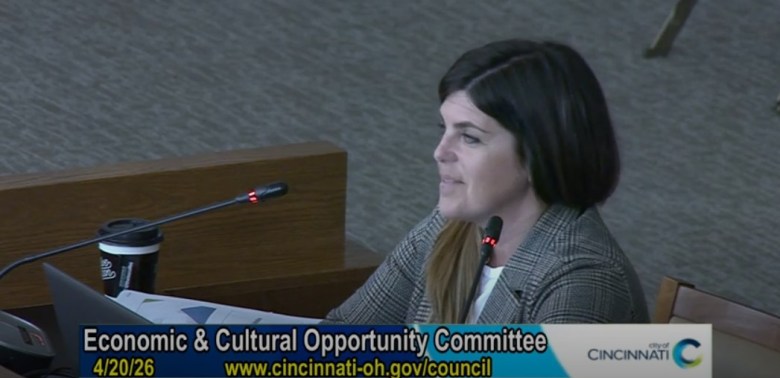
The City of Cincinnati Office of Budget and Evaluation hosted a “Budget Basics” Room 300 is a large, D-shaped space. Members of Cincinnati City Council were seated at a long, curved table adorned with name or position plates. On the far left of the room, a live recording set captured the meeting for a livestream. On the far right wall of the room was a projection screen for slideshow presentations. Audience seating was limited.
Jan-Michele Kearney, chairperson for the Economic and Cultural Opportunity Committee, sat in the center-left. She led the meeting and was very actively engaged with presenters and discussions.
Seth Walsh, vice chair for the committee, sat in the center-right. He was present and engaged with questions until his early departure around 10:50 a.m.
Scotty Johnson, council member and Public Safety and Quality of Life committee chair, sat to the right of the vice chair person. He was present and engaged in discussions.
Anna Albi, council member and Youth and Human Services Committee chair, sat to the left of Kearney. She was present and engaged in discussions. After the end of the meeting, Albi engaged with the woman seated at the city administration seat on whether or not the issue of insurance rates was something within the city’s control to address. (See Agenda Item 2 for clarification)
At the beginning of the meeting there were at least eight audience members. By 10:30 a.m., I was the only audience member left.
Meeting duration: 10 a.m. to 11 a.m.
Council Agenda/Presentations
Both agenda Items were submitted by Vice Mayor Kearney
- 3CDC Summer Programming; Presented by Christy Samad, executive VP of Civic & Commercial Space with 3CDC.
- The program is in full swing with over 600 events planned for the city’s seven civic centers. Sites hosting events include Elm Street Plaza and Fountain Square.
- Goals and central questions surrounding the program are, “How do we keep the city engaged?”, “Help Small businesses” and “How do we complement other events that may be happening at the same time?”
- The program has begun providing food trucks and local musicians during lunch hours for city residents/workers.
- The program also promotes and welcomes tourism through monthly musical headliners.
- The program seeks to make downtown Cincinnati as walkable as possible and works with local businesses to make The Plaza accessible to customers, tourists, residents and workers.
- The program provides smaller events at the civic centers, including trivia nights, open bar nights, improvements on green spaces and dog parks.
- The program provides smaller events (including movie nights, workout classes and grillouts) for residents of Over-The-Rhine at Washington Park. It also encourages tourism with concerts, such as the Friday Flow series.
- It was noted that these are still city assets and thus people can still take out permits for private events at the civic centers around the program’s events.
- The city pools will open on May 9.
- The program appears to run the pool summer camp (with up to 10 weeks of free swim lessons, which residents can sign up for). In 2025, swim lessons served 600 kids and 100 adults.
- The program plans to host a local city swim team and host swim meets.
- The program has partnered with Imagination Alley to host monthly neighborhood nights, grillouts, holiday celebrations, movie nights, etc., to keep the community active and engaged.
- The program has partnered with ArtsWave to bring back bussing for tourists visiting downtown Cincinnati. Bussers can earn an hourly wage and tips.
- Final note: The program has added a piano to Government Square.
- Westwood Townhall Summer Programming, presented by Stephanie Collins, executive director for Westwood Works; Ally Larsson, Westwood Civic Association board member and market operator; and Larry Eiser, president for Town Hall District Business Association & Chair, DORA Management Committee. They presented a slideshow.
Stephanie Collins presented first:
- Westwood Works is a small nonprofit organization that hosts regular free events in and around the Westwood Townhall business district.
- These events include smaller events like fitness classes and two larger events such as Pride and Revive.
- The nonprofit has also created an event program known as Front Yard Fiesta, where it seeks out community leaders to host local block parties for participating neighborhoods. The program provides a stipend to cover food and drinks.
- The program also sends out a volunteer or worker to document the local events hosted within Westwood.
- The nonprofit hosts Howl at the Hall, an outdoor Halloween event at the Westwood town hall that includes an outdoor movie/trick or treating and is open to anyone from the community for free.
- The nonprofit partners with local churches to host Red Door String Quartet and other free musical events. (Started last year and has two events scheduled for 2026).
- The nonprofit hosts Westwood Works Out, which is a rotating list of workout classes at the local park (includes yoga, martial arts, etc.)
- The nonprofit hosts a Summer Steam Program, which educates children with partners like the Cincinnati Museum Center.
- The nonprofit pairs its monthly meetings with community get-togethers and events. (For example, the April meeting will be paired with a Seed and Plant Swap)
Larry Eiser presented second
- The Town Hall District Business Association is looking to attract visitors and future residents. The association seeks to make Westwood a destination for surrounding communities as it sits on the western outset of Cincinnati.
- The yearly lineup includes free concerts hosted at the Westwood Town Hall (the slide says the event is sponsored by General Electric Credit Union) and the Westside Market, which hosts local and regional vendors.
Ally Larsson presented third.
- The Westwood Farmers Market works with local churches and uses their parking lots to host small producers, vendors and farmers to sell their goods. The market is open every Thursday from 4 to 7 p.m.
- The market has a pay-it forward-program. It allows neighbors to donate money so the market is not cost-prohibitive and people of all incomes can participate.
Stephanie Collins presented the benefits and challenges:
- Benefits include removing barriers to participation (due to income), building social connection, providing access to fresh produce and handmade goods, encouraging inclusivity and diversity, and activating public spaces. Westwood is becoming a destination for visitors from downtown, she said. The market improves mental well-being and creates shared experiences, she said.
- Challenges include: The organization is a small nonprofit, funding limitations, lost sponsorships and grants, less income and more expenses, police costs have doubled/worker’s comp coverage is now required, logistical complexities (events not being streamlined). It is restricted to hosting fewer events as a result of lack of funding.
- The presenters acknowledged that for smaller and lesser-funded Cincinnati neighborhoods, these kinds of events may not happen at all due to the current economic strain.
- How can the city help reevaluate and lower the requirements for DORA insurance.,
- Food truck inspection costs limit the nonprofit to a maximum of two food trucks to prevent an inspection.
- Cincinnati police rates have doubled, and worker’s compensation coverage is required.
- Streamline the city’s event-permitting system.
- Prioritize park enhancements for events.
- Create a committee of community development corporations, the Chamber of Commerce, and other large event producers to evaluate process and costs.
What followed was a cordial discussion between the presenters and council about the costs and possible solutions.
- Kearney acknowledged that other neighborhoods do not have the same resources as Westwood. She also seemed excited, sitting up straighter in her seat and speaking up when the presenters mentioned their pay-it-forward program. She would often lean forward and appear happy with the program’s attempts to reduce economic barriers for community participation.
- Johnson said the city’s current contract with the police and fire departments requires time-and-a-half pay for those employees. The increase was to help build the forces’ retirement funds. He also vaguely acknowledged the “current dangers” in America as a reason for the increase in costs.
- Albi thanked the presenters for inviting her to the community chili event. She also spoke about insurance costs and said she was unsure if the city had any control over how the rates were set.
- Eiser responded to Albi by inquiring about thresholds for insurance.
- Kearney closed out the discussion by implying that the council would make addressing the insurance rates a priority.
Without objection, both agenda items were filed and the meeting was adjourned at 11:02 a.m.
If you believe anything in these notes is inaccurate, please email us at documenters@signalcincinnati.org with “Correction Request” in the subject line.
Find more Documenters’ notes here.