
Meeting summary:
- The current infant mortality rate in Hamilton County is a serious issue and a priority for the City of Cincinnati.
- Hamilton County’s 2025 Tax incentive program has been successful.
- Tax incentive agreements are being reviewed effectively, and companies receiving them are staying in compliance.
Documenter’s follow-up question:
- Aside from Cribs for Kids, what other steps to promote safe sleep are being taken in Hamilton County/City of Cincinnati?
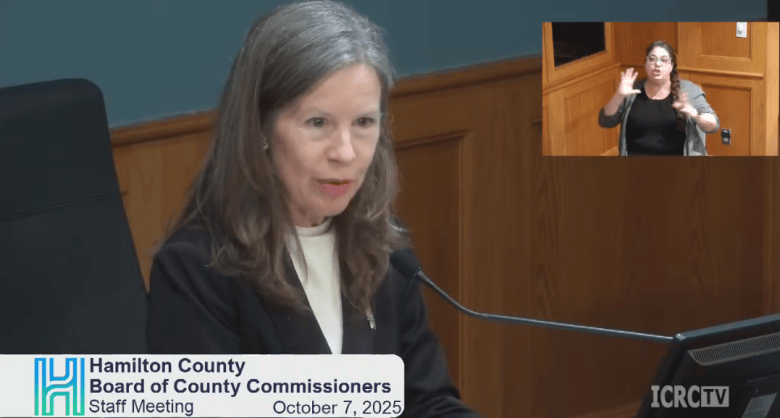
This meeting took place in the Todd B. Portune Center for County Government at 138 E. Court St. in downtown Cincinnati. It was also available to view via livestreaming.
BOCC attendees:
Commissioner Denise Driehaus (President)
Commissioner Stephanie Summerow-Dumas (Vice President)
Commissioner Alicia Reese
Safe Sleep Month
This staff meeting began with the proclamation of October 2025 as Safe Sleep Month in Hamilton County. The goal is to shed light on reducing sleep-related infant deaths. Since 2011, Hamilton County has lost 212 infants to sleep-related deaths, which remain the second leading cause of infant deaths in the community.
In an effort to “give credit where it is due,” Commissioner Driehaus added that Todd Portune championed decreasing the infant mortality rate in Hamilton County 11 years ago.
The Cribs for Kids program is a current safe sleep initiative that has given out over 1,000 cribs to community members in need.
Meredith Smith of Cradle Cincinnati, Commissioner Grant Mussman of the City of Cincinnati Health Department, and Commissioner Greg Kesterman of the Hamilton County Health Department were in attendance and received recognition for their amazing work in promoting safe sleep and overall infant and maternal health.
According to Smith, change is possible if we continue to push safe sleep through “Alone, Back, Crib” messaging.
Tax Incentive Review Council
Michael Whidden of Alloy Development’s economic development department presented the current status of the TIRC.
The purpose of TIRC is to meet annually to review all outstanding tax agreements, locate enterprises and make recommendations to the board regarding these agreements. TIRC has seven voting members, including a mix of community residents and individuals appointed by the BOCC and the Cincinnati Board of Education.
The Enterprise Zone currently has 15 active agreements, including four agreements in construction.
The Community Reinvestment Area (CRA) has four active agreements with three agreements in the construction period.
Real property, personal property and employment are the metrics considered in each agreement.
Three active agreements have expired, bringing the estimated amount returning to the tax roll to about $91,000.
Enterprise Zone continued the vast majority of programs, which, according to Whidden, is a good sign of compliance with all terms.
Whidden added that overall this program is performing well.
Commissioner Driehaus said she is glad to see the program working.
These notes can be found on documenters.org.
If you believe anything in these notes is inaccurate, please email us at documenters@signalcincinnati.org with “Correction Request” in the subject line.
Find more Documenters’ notes on Cincinnati City Council here.