
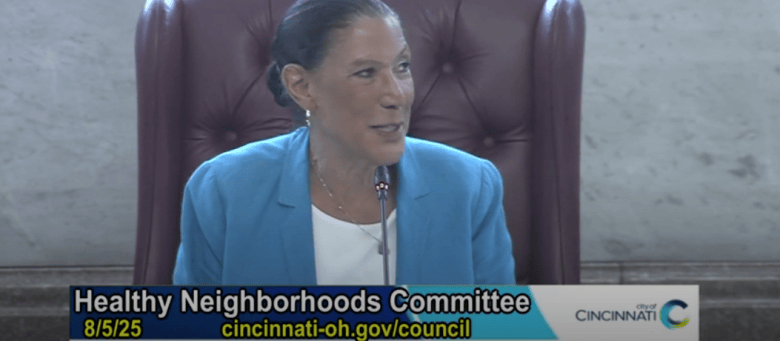
Meeting summary:
- Members of Cincinnati City Council’s Healthy Neighborhoods Committee discussed ways the city could assist in addressing nursing homes in the city with bad conditions.
- The committee discussed this today in response to public comments from Stephan Pryor, who has spoken in front of council numerous times about senior citizen and nursing home issues.
Documenter’s follow-up question:
- The resolutions passed to support efforts to help seniors do not include specific plans. Is it a priority for the city to address this?
- How can these entities be proactive in addressing concerns before it gets to the complaint level? This was a question from Council Member Anna Albi.
The Healthy Neighborhoods committee meeting Tuesday was called to order at 11:50 a.m. It was scheduled to begin at 11 a.m., but the Public Safety and Governance Committee ran two and a half hours.
Committee members present:
- Vice Mayor Jan-Michele Lemon Kearney
- Council Member Mark Jeffreys
- Council Member Meeka Owens
- Council Member Scotty Johnson
President Pro Tem Victoria Parks(excused)
Also present were Monica Windholtz, assistant city attorney; and Lisa Carrion, deputy clerk of council.
The main focus of the committee meeting was discussing senior citizen issues.
Stephan Pryor spoke during public comment to advocate for seniors. Much of Tuesday’s meeting was inspired by Pryor’s public comments at previous public meetings.
Stephan Pryor advocates for seniors in nursing homes in public comment
During the meeting’s public comment portion, Stephan Pryor told the committee he is speaking on behalf of seniors. He heard about bad nursing home conditions from his friends, and he’s also visited communities and investigated the issues himself.
He named nursing homes across the city where he has seen issues with cleanliness, nutrition and food, and mistreatment of seniors. He named nursing homes in Clifton, Avondale, Western Hills and others where he’s noticed problems.
At one nursing home, he said he found black mold in one of the resident’s rooms. He also noticed a rusted-out door, a bad odor permeating the facility, and other unsanitary conditions.
He is worried about whether the seniors in these facilities are treated with respect and dignity. In one, he said, a wealthy resident was being targeted by staff for her money.
Unhealthy food was also a common issue. Once, he saw a woman receive a hamburger bun and fries – no meat.
“That’s what you feed birds, and that’s wrong,” Pryor said. “Check on these residents. It’s real bad in there.”
Communications
Item 1 on the agenda was communications.
Three speakers were brought in to address senior citizen concerns: Dr. Grant Mussman, city health commissioner; Sandra Jones Mitchell, founder and executive director of Serving Older Adults Through Changing Times (SO-ACT), and Eric Carpenter, with Pro Seniors.
Dr. Grant Mussman, Cincinnati Health Department
Health Commissioner Mussman said the health department does respond to nursing home complaints: “We try to do what we can” at the Cincinnati Health Department (CHD), he said.
Kearney said she’d like to get a representative from the Ohio Legislature in council chambers to talk about these issues, especially those regarding mold and overall cleanliness.
Council Member Anna Albi remembered a time when the owners of a local McDonald’s franchise came to deliver food to a nursing home that wasn’t feeding seniors enough. Mussman said he remembered that situation: “We wound up being in the ‘picking up the pieces’ stage instead of being more in front of it.”
Albi questioned how CHD could be more proactive in responding to complaints. Mussman said many issues are complaint-based, not inspection-based. Inspections mostly relate to food sanitation. Also, patient-based complaints are investigated, related usually to standard of care.
In regards to proactivity with nursing home issues, Mussman said he is not familiar with all the discussions that are had in city departments such as Buildings & Inspections and the city manager’s office.
“We are certainly willing to do what our elected officials and community want us to do,” he said.
Call or report other issues and violations to CHD, he said.
[Editors note: The number to call is (513) 357-7200]
Sandra Jones Mitchell, SO-ACT
SO-ACT, a nonprofit that advocates for seniors, started in response to concerns at a nursing home in Avondale, said Mitchell, founder and executive director. At the time, Avondale had 26 nursing homes. Now the neighborhood only has two.
At that time, CHD had nurses and inspectors go into these facilities to ensure food, service and activities were all in order. The Cincinnati Human Relations Department used to fund those programs.
SO-ACT has a volunteer crew, known as ambassadors, that perform the same duties. But they’re not paid and have a small staff of only three ambassadors. Staff turnover is high at nursing homes – another reason this is needed. Nursing homes used to have in-house social workers, but that is less common these days.
“We have to just do a better job … this is nothing new to me. I’m hoping you can bring folks down here who can change some of the laws,” Mitchell said.
Eric Carpenter, Pro Seniors
Pro Seniors started in 1975 as a legal aid organization. It helps Ohioans 60 and older with legal problems and questions, helps seniors learn about frauds and scams (especially related to Medicare), and employs staff resident rights advocates who respond to complaints in long-term-care facilities.
Top complaints Pro Seniors receives, according to Carpenter:
- Medicaid or Medicare issues: Involuntary discharge happens often. Medicare drops patients, usually for financial reasons.
- Care planning: Each patient receives an individualized care plan. Nursing home staff is supposed to work with the family on how to implement it, but that doesn’t often happen. Complaints regarding missing, late or wrong medications are also common.
- Dignity and respect: Underreported but common. Hygiene and incontinence care are often neglected, including shower access and food problems.
- Falls. Staffing causes 90% of these issues, with inexperienced or not enough staff driving falls.
Abuse is not a super common complaint, but Pro Seniors does respond to such complaints, he said. Psychological abuse also happens, which bleeds into the dignity and respect portion of complaints.
Some nursing homes are skirting Esther’s Law requirements, writing policies such as residents can‘t use WiFi in their rooms due to bandwidth problems. Esther’s Law allows patients’ families to place monitoring devices in their rooms.
Involuntary discharge is frequent and can be dangerous, especially if a home sends you to a hotel or homeless shelter.
Call Pro Seniors complaint hotline at 513-458-5518. Legal help line is 513-345-1460
Agenda items
Kearney introduced agenda items.
Items 1 and 2 related to seeing how council can use Pro Seniors services to help with these issues.
Item 3 was a motion to reallocate $250,000 from the carryover of local business support to Grow Avondale Businesses initiative. The Urban League worked with businesses at Avondale Towne Center to see what they needed to succeed.
The program would help those existing businesses expand, provide technical support, and assist other businesses that want to move into the Towne Center to get the resources they need.
Moved on for full passage by City Council.
Item 4: An ordinance that would declare Gholson Avenue at Reading Road to be renamed Patricia Milton Way.
Mitchell, who is also president of the Avondale Community Council, approached the podium again to make comments on this ordinance.
She said it is a wonderful opportunity for the city to recognize someone who has given countless hours to the Avondale Development Corp.
“If it wasn’t for her leadership, we wouldn’t be (in) the building we’re in,” Mitchell said.
Kearney added: “Sometimes people are forgotten, which is why I like street names. It is part of our 52 neighborhood’s history.”
Meeting adjourned at 12:54 p.m.
You can find these notes on Documenters.org
If you believe anything in these notes is inaccurate, please email us at documenters@signalcincinnati.org with “Correction Request” in the subject line.
Find more Documenters’ notes on Cincinnati City Council here.