
Meeting summary:
- Hamilton County commissioners expressed several concerns about the proposed build-out of the Banks, an entertainment district that would include high-rise residences, a hotel, Ferris wheel, public plazas and more.
- The Metropolitan Sewer District is requesting a 4.5% rate increase for customers in its 2026 operating budget.
- The Hamilton County sheriff wants more money to reach a full complement of 972 full-time employees and staff a 24-hour-a-day operations center in 2026.
Documenter’s follow-up question:
- What can the planner for the Banks do to design the development to maintain the historical significance of the National Underground Railroad Freedom Center?
- How will the Metropolitan Sewer District sell another rate hike request to customers who are dealing with higher costs brought about by tariffs and an immigration crackdown that is leaving the United States with a smaller labor force?
Notes
Scene
The meeting was held, as it is normally, in Room 603 at the Todd B. Portune Center for County Government, 138 E. Court St., in downtown Cincinnati. Spectators and presenters were in attendance, as were the three commissioners, an assistant county prosecutor, county administrator, assistant commission clerk and chief clerk. The commission’s YouTube feed began at approximately 10:09 a.m. The meeting adjourned at 1:23 p.m.
Commissioners present
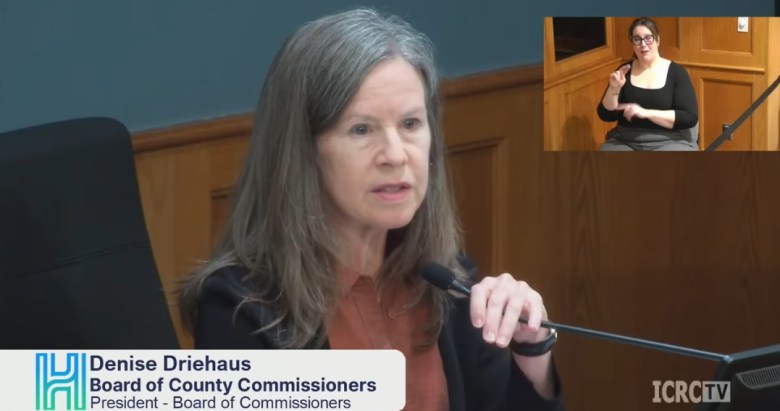
- Denise Driehaus, president
- Stephanie Summerow Dumas, vice president
- Alicia Reece, commissioner
- Jeff Aluotto, county administrator
- Patrick Dressing, assistant prosecuting attorney
Approximate time spent during the meeting
- 15 minutes: Proclamation for sheriff’s deputies
- 43 minutes: The Banks Plan Update
- 40 minutes: Hamilton County Sheriff’s 2026 Budget Update
- 53 minutes: Metropolitan Sewer District 2026 Budget Update
- 29 minutes: County Veteran Services Commission 2026 Budget Update
Agenda
The agenda featured three items:
ITEM 1. Retirement of sheriff’s Deputies James Rehn, Gary Houston
Hamilton County sheriff’s Deputies James Rehn (a 34-year veteran) and Gary Houston (a 35-year veteran) were honored with a proclamation making “Nov. 18, 2025, Gary and Jim Day In All of Hamilton County, Ohio.”
Rehn and Houston started their careers as part of the county jail force and worked their way up to become security for the county administration building.
“We just could not be more thrilled to honor the two of you. This room is packed for a reason. You are well loved by everybody you come in contact with, and that’s everybody in the building,” Driehaus said.
“They’ve been together so long,” Summerow Dumas said, “they look alike.”
Reece said she wanted to do a proclamation that would not allow them to retire, but the prosecutor’s office said no.
“You are the front door to Hamilton County,” she said. “I call ya’ll the Doobie Brothers. Thank you for being a part of our Hamilton County family.”
Rehn and Houston thanked family, friends and everyone in the room for their support and good wishes. Houston offered special thanks to his partner “for not Tasing me.”
ITEM 2. The Banks Urban Plan Update
The presentation is to discuss “how we’re going to finish out the Banks,” Driehaus said. “We all have said it’s high time.… We’re filling out the final lots” of property.
The Banks Project Executive Phil Beck said representatives from the city, county, Reds and Bengals make up the Banks Urban Plan Update steering committee, which named urban planning consultant Perkins & Will in mid-April. Fourteen proposals were submitted, Beck said.
Andrew Broderick, the Perkins & Will associate principal who presented the proposal, said the goal is to reposition Banks-owned property for development via a developer team starting in 2026. The primary focus is five lots of property to the north and east of Paycor, on the west end of the Banks. Ninety percent of those five parcels are planned for residential living.
The project is 25 years in the making, he said. Perkins & Will wants to reinvigorate the Banks, a gateway to the city and the region, as a unified and cohesive vision for its future.
Broderick said highlights of the development include plazas in front of the National Underground Railroad Freedom Center museum and Cincinnati Black Music Walk of Fame, a Ferris Wheel across from the Freedom Center, a marina near Great American Ball Park, and 2.1 million square feet of vertical residential space.
Mark Kubaczyk, director HR&A Advisors, conducted market analysis for the district. While office space is a challenging use at this time, he said, a full build-out of the development will take five to 15 years.
Development costs of the five properties are estimated at $750 million to $800 million (for retail, office, hotel, mid-rise and high-rise residential), Kubaczyk said, noting that each residential type requires subsidy.
The Banks is an “ambitious project that requires an amount of public investment,” he said. “The degree of that investment is relative” (the more interest rates fall, feasibility in the project will improve, he said).
Broderick agreed with Driehaus that public investment refers to building more parking garages. Beck estimated the cost of building a garage, including utilities and designed for a multi-structure facility, at $25 million to $30 million a square block.
Driehaus asked several questions about the proposal, noting the height of some of the buildings proposed is “disconcerting.” She also said she had not envisioned a hotel as part of the proposal.
In response, Broderick said the building heights are being driven in part by market forces. Kubaczyk said it’s not all that strange to have hotels in and around stadium districts. Developers have said there is a bullishness toward one hotel – and perhaps a second – between the stadiums.
Broderick said, “We think more people can call this site home,” referring to the proposed location for a high-rise residential building just south of Third Street.
Summerow Dumas said, “I’m not sure [the proposal] is a priority for me.”
Reece added her concerns. “For me, we’ve gotta take a step back,” she said, noting the proposal might be the third or fourth plan for the Banks. “I want to know who is in charge of making decisions.” She suggested making the steering committee more diverse.
“I don’t want a country club group making decisions on a public project” she said, refocusing her concerns about a perceived lack of diversity on the steering committee. She reminded everyone that the commissioners have to answer to the entire county: “Anderson Township wants to know what this project means to them.”
Reece said she thinks “the timing is off to be running with the Banks” when there are other issues (property taxes, upgrades to Paycor Stadium). “Things are kind of tight” in terms of county finances, she said.
“What are the obligations of the county?” she asked.
Reece pointed out that the county owns about 70% of the land in the district. “I’m interested in tying up the deeds,” she said, noting that, in her opinion, the county should lease and not sell in order to keep control of the Banks development. “We also need air rights,” she said. “I agree we shouldn’t have buildings blocking the skyline.”
She asked the county administrator to look at the county’s current debt load and how much debt will be added because of the Banks build-out.
About the National Underground Railroad Freedom Center, Reece said she voted for the first $10 million for the center when she was on Cincinnati City Council and voted for funding later as a state lawmaker. “Now, it’s there as an afterthought [in the proposal].” She called it disrespectful to propose installing a Ferris wheel and entertainment plaza in front of the Freedom Center.
She also said she is opposed to any plaza that hides the Cincinnati Black Music Walk of Fame, as the proposal would likely do, creating pedestrian-only streets because the county population is aging, she said, and allowing DORAs has created a climate that is challenging safety.
ITEM 3. Hamilton County Sheriff’s Office 2026 Operating Budget
Sheriff Charmaine McGuffey said her budget update includes asking the commission to continue funding for a new gun range and the continued build-out of a real-time operations center as part of a 10-year contract that includes body-worn cameras and drones. She said her goal is to create a real-time operations center staffed 24 hours a day in the next five years.
The sheriff’s budget also calls for a new Jail Management System (to collect data on inmates) and an automated finger ID system (to more quickly ID people), both to be fully operational by mid-2026.
McGuffey said she still has to continue negotiating a livable wage. The union negotiating for sheriff’s employees is calling for a 4% COLA. “And we want to push back on that,” she said.
In 2025, the sheriff’s office employed 908 actual full-time employees (972 slots were approved). In 2023, retirements lowered the FTE number to 800. The FTEs jumped to 882 in 2024. “We’ve reversed that trend” of losing full-time employees.
Recruiting efforts for support positions will be individually evaluated before jobs are filled, the sheriff said, and the HCSO also will be focused on evaluating overtime.
The HCSO 2026 budget request is $136.6 million, which assumes a full FTE complement of 975. The target budget request is $116.3 million.
She said the sheriff’s office is starting in the hole because the 2026 budget allocated $98.2 million in the target budget request for personnel, a 2% drop from 2025.
“We are in position to create a fully funded jail,” she said, noting that a number of quality personnel is needed to handle the increasing number of people brought to the jail.
ITEM 4. Metropolitan Sewer District 2026 Operating Budget, CIP
The Metropolitan Sewer District of Greater Cincinnati is asking for $255.9 million for 2026, a 6.3% increase over 2025, MSD Director Diana Christy said.
MSD is recommending an Operations and Maintenance budget of $158.7 million, a $12 million increase (8.2%) from the 2025 O&M budget. That number calls for a 12% increase in personnel – $8 million – over 2025.
Generation costs have increased by 27% as the retirement of older power plants and long lead time for building plants have reduced available energy supply. Consumers face an overall average tariff rate of 17.9%, the highest since 1934, an increase of more than 15% from 2024.
The 2026 capital budget request calls for a five-year improvement plan, which includes an anticipated Capital Improvement Program totaling $153,604,637. The commissioners will be approving $84,418,116 in December; the rest ($69,186,521) is for 12 projects expected to be approved by the board throughout 2026.
2026 Revised Rates: MSD is recommending a system-wide increase of 4.5%. Increase includes inflow and infiltration costs, part of which is associated with groundwater and wet weather. Some customers will see no increase depending on how much water is used. The minimum charge will remain the same for some. Others will see bills increase from 4% to 16% for big industrial and commercial users.
Public hearings are scheduled for Dec. 2 (at the county administration building ) and Dec. 9 (at the county board of elections facility in Norwood.)
ITEM 5. Veterans Commission 2026 Budget
Commissioner Glen Welling, hired full-time in September, said the Veteran Service Commission wants to be the best in Ohio. Right now, more than $500,000 is flowing back to the county from the federal government in claims assistance.
Year to date, more than 500 veterans have been given financial assistance — food, utilities, clothing and more, according to Welling’s presentation to the commissioners.
The VSC’s total budget request for 2026 is $3,203,534 (a 6% increase from 2025), which includes $817,500 for veteran relief (a substantial portion — $500,000 — focused on financial assistance.
“We can’t help people if they don’t know we exist,” Welling said in response to concerns from Driehaus and Summerow Dumas about the amount being budgeted for marketing ($543,400).
Reece, Driehaus and Summerow Dumas praised Welling for “showing a new day” for his administration. Prior to his arrival, the Hamilton County VSC officers didn’t even come to the county commissioner meetings to talk about the agency’s spending plans or ideas, Reece said.
“When [veterans] come home, they need to be treated like heroes, not zeroes,” Reece said, adding that she wants the county VSC to commit to creating more partnerships.
Welling said the county VSC is working to create the partnerships Reece suggested.
Public Comment: None
The meeting was adjourned at 1:23 p.m.
These notes can be found on documenters.org.
If you believe anything in these notes is inaccurate, please email us at documenters@signalcincinnati.org with “Correction Request” in the subject line.
Find more Documenters’ notes on Cincinnati City Council here.