

Cincinnati Documenters are in the room where decisions are made that matter to you. Each month, we bring you a highlight from significant moments in our “In the Room” series.
Plans for new streetcar lines may not be on the horizon, but Cincinnati Metro is just a few years away from launching new bus lines with rail-like efficiency.
In six months, Southwest Ohio Regional Transit Authority (SORTA/Metro) will start construction on its bus rapid transit (BRT) project – bus lines with a “light rail perspective,” said Sharyn LaCombe, senior director for BRT and design at Metro. Called MetroRapid, it is one of 11 projects across the nation headed for approval by the Federal Transit Administration.
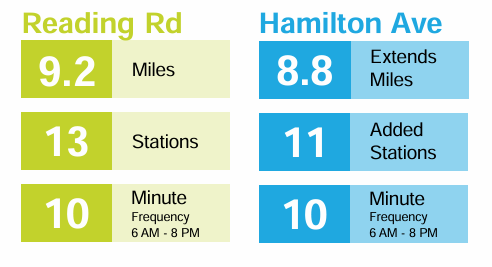
MetroRapid will have two corridors: Reading Road, at 9.2 miles long with 13 stations, and Hamilton Avenue, at 8.8 miles long with 11 stations. It is expected to decrease travel times on those lines by 20%.
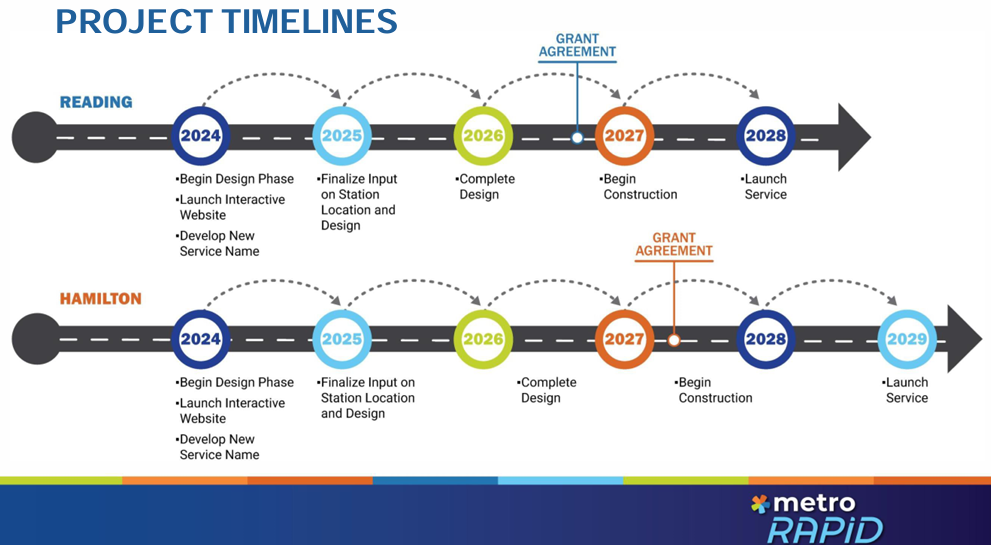
The total project cost is about $350 million, using a combination of federal grants and revenue from 2020’s Issue 7 levy in Hamilton County, which implemented a 0.08% sales tax.
LaCombe, along with Metro’s project deputy innovation and vision officer, Khaled Shammout, presented the project to the Cincinnati City Council Climate, City Services and Infrastructure Committee last week. The impetus for the project was Hamilton County voters passing
The BRT designs come as Metro ridership is reaching an all-time high, LaCombe said. For example, the 43 bus line on Reading Road serves 4,000 to 5,000 riders a day. A projected ridership of 6,000 to 7,000 a day is expected once the new route is operational.
“It’s going to be a substantial increase,” Shammout said.
Picture this: You just got out of class at University of Cincinnati and want to get lunch at The Banks. Every five minutes, a different bus will pull up to take you to the Riverfront. Once you finish lunch, you need to head to your late-afternoon class. You can get right back on the bus and take it straight back to UC.
“If you’re just traveling between those two places, it will be mindless,” LaCombe said. “You just walk out of the station, hop on, just like the streetcar, and it will take us up to the university and the hospital district.”
The project will also resurface 5.82 miles of streets, improve and upgrade 62 pedestrian crossings within 2 miles of the new transit stations, and offer audio enhancements for hearing-impaired residents. Sixty-foot buses have also been ordered to accommodate an increase in ridership. (A typical city bus is 40 feet long.)
Could it be better? Council member compares MetroRapid to other cities’ BRT
According to the Federal Transit Administration, BRT is operating in cities including New York, Los Angeles, Boston and Cleveland and also gaining steam in mid-size cities like Indianapolis and Minneapolis. Since 2016, 317 miles of BRT lines have been put into service in the U.S.
MetroRapid is expected to reduce travel time by 20%. During the committee meeting, Council Member Mark Jeffreys noted there was a 26% reduction in Cleveland travel times; 33% in Richmond, Virgina; and 50% in Hartford, Connecticut.
“So my question is, should we be setting our goal higher?” he asked. “Because I think especially these first routes are going to be key to having people see the benefit.”
Shammout said there are certain constraints in terms of the right-of-way that could pre-determine travel times, among other factors. This is the first BRT system in Cincinnati, and he said they want to be conservative at the beginning.
“As we learn and as people adjust, maybe there are things we can keep tweaking and get higher than 20%,” he said. “And I think we will.”
What about traffic calming?
In recent years, the Cincinnati Department of Transportation and Engineering (DOTE) has enacted traffic calming measures on Hamilton Avenue and other thoroughfares. Lanes have been reduced through College Hill with speed cushions, raised curbs, bump-outs and other so-called road diet measures in an effort to reduce speeding and traffic crashes. Mount Healthy has also enacted similar measures on Hamilton Avenue.
In a statement to Signal Cincinnati, Metro spokesperson Bradley Mason said they are continually coordinating with DOTE as well as North College Hill and Mount Healthy on MetroRapid’s design. Both North College Hill and Mount Healthy have reviewed the 30% of the design plans for their respective communities, and Cincinnati’s DOTE has reviewed the 60% design plans for the Reading Road corridor, he said.
Collaborating with the local governments allows Metro to account for both existing street conditions and the planned improvements, Mason wrote in the statement, including preserving or restoring features such as speed humps and curb bump-outs if affected by construction.
If you believe anything in these notes is inaccurate, please email us at documenters@signalcincinnati.org with “Correction Request” in the subject line.
Find more Documenters’ notes here.