
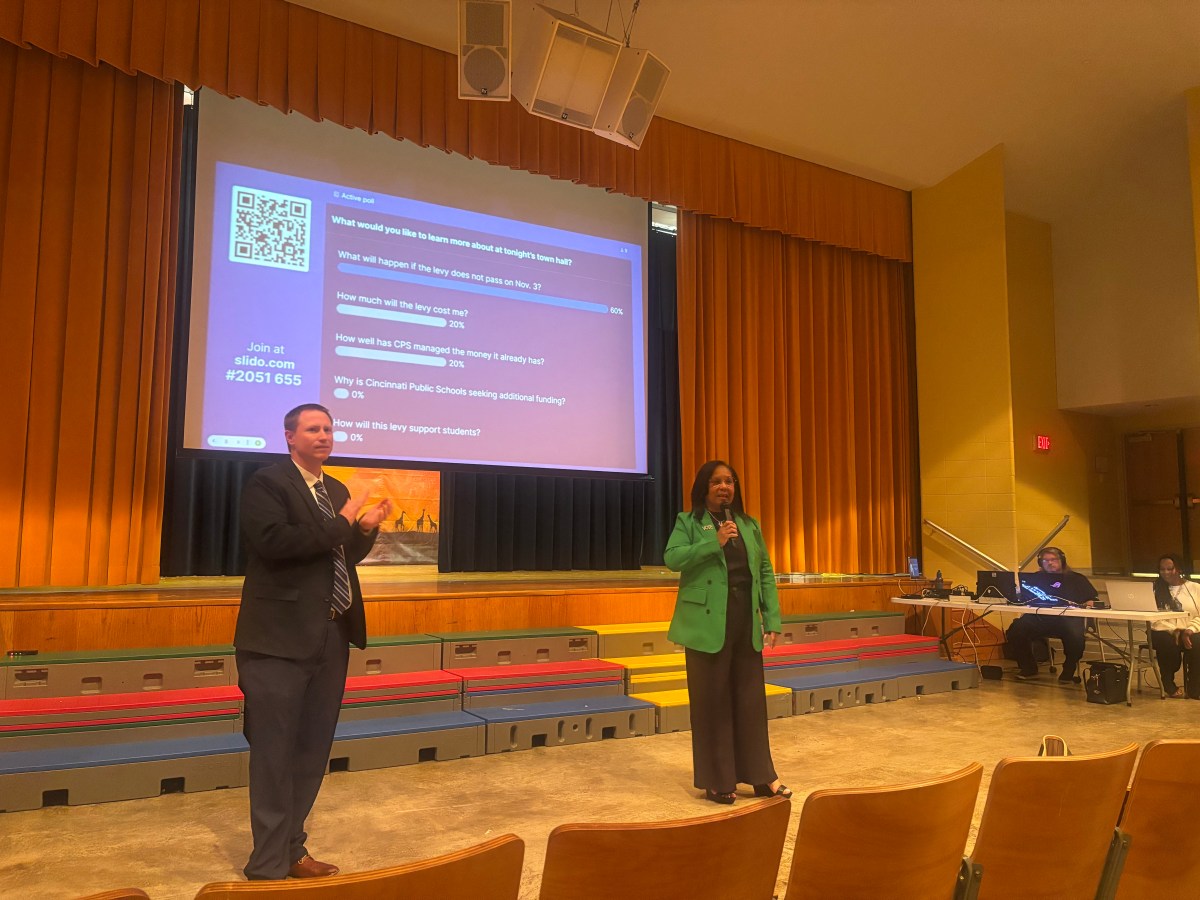
What will happen if the levy doesn’t pass? How much will the levy cost homeowners? How well has Cincinnati Public Schools (CPS) managed the money it already has, and what caused the debt in the first place?
These were the questions community members asked at a town hall meeting led by CPS officials Tuesday evening regarding a proposed additional levy on the Nov. 3 ballot.
Officials answered parent and caregiver questions, but the biggest one they aimed to answer is, what’s at stake?
“One of the goals … is to make sure that we are giving the best of CPS to every student in our school district,” Superintendent Shauna Murphy said, noting that the district has recently received its first three-star rating in 15 years. “We’re super proud of that, [but] we have a lot more work to do.”
This is the first time in 10 years the district has requested a new operating levy, according to a levy info page on CPS’ website. If passed by Cincinnati voters, this 7 millage operating levy would generate $66.3 million in revenue over five years. It would cost the owner of a $100,000 market-value home approximately $245 a year, or $20.42 monthly.
CPS closed a projected budget gap of nearly $58 million ahead of Fiscal Year 2027, by reducing staffing and non-personnel spending, implementing furlough days, and securing outside funding, among other measures.
With additional levy money, the district has pledged to protect classroom resources and sustain student support, preserve college and career pathway programs, and maintain arts, athletics and other extracurricular experiences.
During the meeting, CPS Treasurer Michael Gustin said the district would also be able to fund delayed facility maintenance that’s been planned since 2006. Twenty years later, the district has 6,000 more students than initially projected, which led to adding more schools to the district.
If the levy does not pass, the district would lose between $20 million and $25 million per year. Gustin called that a “scary” scenario.
“So every year, your choice of what to cut, you take out the things you cut the previous year and you look at the things that are state-required,” Gustin said. “And it gets harder and harder to maintain the programs that this community relies upon.”
CPS offers programs that aren’t required by the state, such as athletics, band, high school choice and Montessori schools. Anything that’s not state-required could be cut, he said. However, Murphy and Gustin could not specifically say what exactly would be cut in the event of a failed levy, as they would first present plans to the school board.
A community member at the meeting asked what got the district into debt in the first place.
According to Murphy, the state has chosen to fund private and charter schools in addition to traditional public schools: “Same amount of money, but three different systems,” she explained. CPS is not the only district experiencing budget shortcomings as a result, she said.
The money split between three systems is in reference to Ohio’s EdChoice scholarship program, which provides families with vouchers to use at private and charter schools instead of public schools. The program is currently being challenged in court by more than 300 school districts – CPS among them. An appeals court on Thursday ruled it unconstitutional, but the state is expected to appeal yet again.
More information about the levy can be found on CPS’ website. Election Day is Nov. 3. You can find your polling place and other information about early voting on the Hamilton County Board of Elections’ website.
If you believe anything in these notes is inaccurate, please email us at documenters@signalcincinnati.org with “Correction Request” in the subject line.
Find more Documenters’ notes here.