
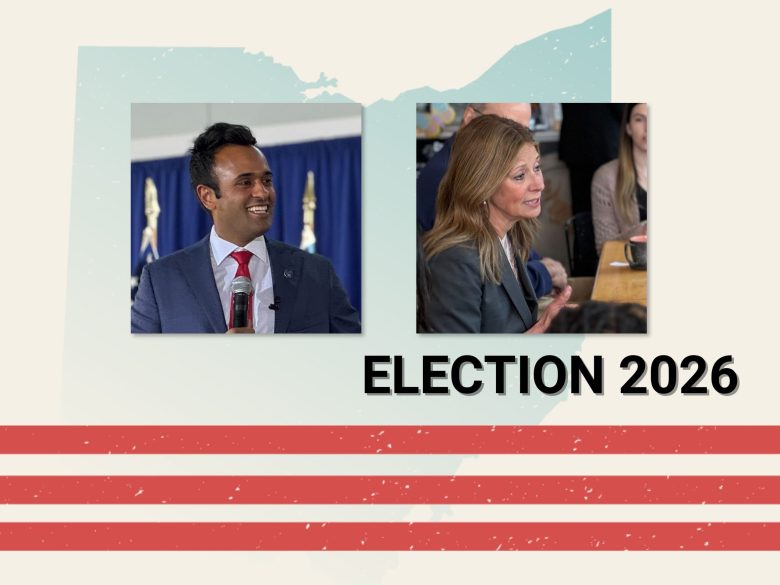
Ohio’s gubernatorial candidates are popping up at university football games, off-campus bars and college auditoriums across the state – with more visits on the way ahead of Election Day.
Democrat Amy Acton and Republican Vivek Ramaswamy have made at least 13 combined campus-area stops since January, according to the information shared on the candidates’ websites and social media platforms reviewed by Signal Statewide.
Acton has made at least eight stops on or near one of the state’s higher education institutions since January. Ramaswamy has made at least five, with one visit scheduled for mid-October.
Several appearances came in areas populated by their parties’ base voters. Acton visited Ohio University’s main campus in Athens twice so far this year. Residents in both the city and county of the same name supported Kamala Harris over now-President Donald Trump in the 2024 presidential election.
Ramaswamy visited the Buckeye Career Center in June. Its New Philadelphia campus sits in a county where voters overwhelmingly backed Trump two years ago.
But they’ve each also visited areas with fewer members of their constituencies.
Ramaswamy made his own stop in Athens, hosting a “Bobcats for Vivek” rally at an off-campus bar Sept. 26. Acton headed to a career center in rural Gallia County last month, an area where nearly 80% of voters supported Trump in 2024.
Neither candidate publicly shared information about any recent visits to schools in the northwest or northeast parts of the state.
Kent State University President Todd Diacon seemingly invited Ramaswamy to visit back in April after the candidate first shared his plans to consolidate some of the state’s universities due to low enrollment and financial challenges.
University officials told Signal Statewide Ramaswamy hasn’t yet taken Diacon up on that offer.
College campuses not often target of campaigns
Typically, college campaigning isn’t a priority for either party given that young voters historically turn out at lower rates, according to Austin Trantham, an assistant professor at Florida’s Saint Leo University, who’s researched the geography of gubernatorial campaigns.
His findings show gubernatorial candidates ultimately prioritize stops in areas with higher voter turnout rates or areas filled with their party’s base voters.
Still, Trantham thinks there could be potential benefits to campus-area stops when it comes to shaping a perception of a candidate. Online recaps show the candidates both highlight topics relevant to students during these stops, including concerns over student loan debt and getting a job.
Campus-area visits can help project an “image of being engaged with younger voters and the issues that matter to them,” he told Signal Statewide via email.
“In our social media driven campaign environment, the images and content generated by these appearances can reach audiences well beyond the campus itself,” Trantham wrote.
Federal law says nonprofit colleges can’t directly participate in political campaign activities in order to keep their tax-exempt status. But candidates can appear on campus in other ways, including when invited by students or professors.
Ramaswamy’s call to consolidate colleges becomes campaign issue
Trantham said it can be difficult to track gubernatorial campaigns due to a lack of data. Schedules tend to be fluid. Stops get changed on short notice, and details for many events are often not shared in advance.
Ohio’s race also features varying levels of press availability. More of Ramaswamy’s campus events have been open to the media than Acton’s, offering a clearer window into when he receives criticism.
That includes a visit to Ohio State University in April, when WOSU reported that audience members “criticized and questioned” him. The crowd booed him during an appearance at Cincinnati’s Xavier University in July, according to the Cincinnati Enquirer. Conservative-leaning student groups hosted both events.
And though Ramaswamy walked back his initial calls to consolidate schools, the comments have followed him. Last week, he told reporters he’s “the person who saves the long-run sustainability of public universities,” according to the Toledo Blade.

A political action committee called Bring Ohio Back Now, which as a 501(c)(4) is allowed to favor or oppose issues supported by candidates, tried to exploit the criticism of Ramaswamy’s proposal.
Last month, the PAC sponsored 12 billboards near college campuses that warned Ramaswamy’s proposal could “wipe out Ohio colleges.”
The billboards targeted students at Kent State, Youngstown State University, Lorain County Community College, Stark State College and Bowling Green State University, along with Shawnee State University and Wright State University in the southern part of the state. Many of the billboards remain up.
The Acton campaign continues to slam Ramaswamy’s plans, including in social media posts recapping Acton’s campus campaigning.
Campaign spokeswoman Virginia Schaus said Acton is visiting colleges in order to hear from students and educators “about the issues that matter most to them, from access to higher education to affordability.”
Ramaswamy’s campaign did not respond to Signal Statewide’s related questions.