
With another year of deficits expected, Cincinnati officials are prepping a new budget.
Leaders are bracing for cuts across all city departments for Fiscal Year (FY) 2027, which runs Oct. 1, 2026, to Sept. 30, 2027. Council must pass all final appropriations by June 30, a few months ahead of the next fiscal year.
But before city council members sign off on it, the community, mayor and city manager get to have their say in what goes in it. Community engagement is underway now, explained Budget Director Andrew Dudas in an April 8 “budget basics” meeting to engage the public in the process.
For FY-2027, the total general fund deficit is expected to be $29.5 million. That means department heads have to tighten what the city spends in order to fill the gap.
This is how the process works, according to Dudas and city officials.
Where does the city’s money come from and how is it spent?
City revenue comes from a combination of taxes, fines and other sources. The goal is to pass a “structurally balanced budget,” which means all ongoing expenses are covered with ongoing sources of revenue, Dudas said. One-time revenue sources would create a “balanced” budget, but including them wouldn’t meet the standards of structurally balanced.
There are three main types of revenue:
- General fund revenue: Revenue from income and property taxes, state-shared revenue, and various other local taxes and fees fund the general operations of the city, such as public safety and public services.
- Restricted fund revenue: Some revenue generated for a specific purpose is restricted to use for that purpose, such as grant funds.
- Enterprise fund revenue: Revenue from city services that operate like business, such as Greater Cincinnati Water Works and the Convention Center, remains within those services.
In FY 2026, the total general fund revenue was $569.5 million. Local earnings tax comprised 65.1% of general fund revenue, or $370.8 million.
About half of the general fund goes to public safety – police and fire departments. Each other city service receives less than 5% of that budget, except for the city manager’s office, which received about 9% last fiscal year.
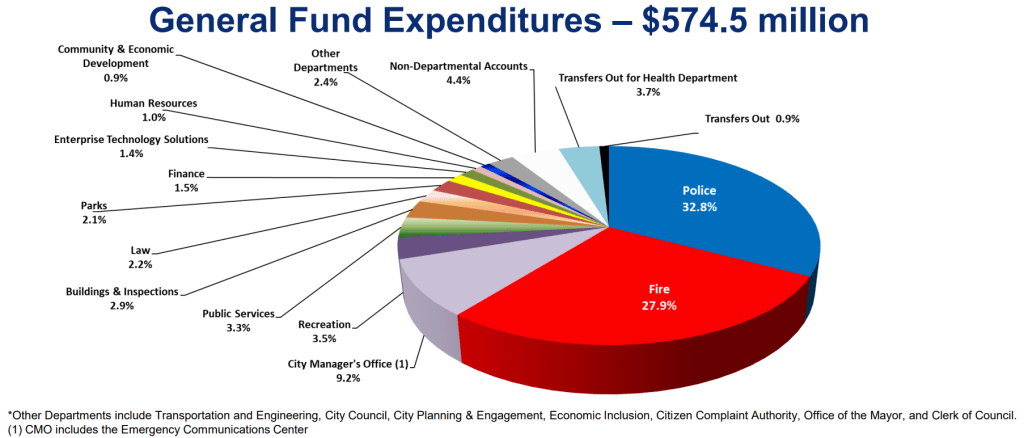
About 80.9% of the general fund goes to personnel and benefits for each city department.
What is attributed to the 5% budget cut to fill the $29.5 million deficit?
Department heads have to make budget requests. In order to fill the $29.5 million deficit, they must find a way to cut 5% of their respective budgets to meet that gap.
Federal support from the American Rescue Plan Act, dispersed during the COVID-19 pandemic, has now run out. The city now has to make another plan to close the deficit that for five years was aided by those federal funds.
Who holds the power in controlling the budget?
City Council always has the final say in what the final budget will look like, but before it comes to their desks, the city manager and mayor will get to make their own tweaks. Not all local governments allow the city manager and mayor to be involved in the process in that manner, but Cincinnati’s charter calls for their input.
One of the largest parts of the community engagement process is the leveraged support fund. The city gives money to private organizations that provide a public good – in the arts, economic development, environment, equity and inclusion, social and human services, and more.
Many organizations send representatives to council meetings during that time to make pitches about why public money should be put into their business or nonprofit. Last year, more than $10.7 million was spread across organizations.
Where is railroad money going?
In 2023, Cincinnati voters approved a measure to sell the city-owned railroad. Money from the $1.6 billion sale will be dispersed each year. It is called the Cincy on Track initiative. The money goes to five main categories: streets and bridges, parks, recreation, health and public services.
Last fiscal year, trust disbursements totaled $56 million. A majority of that, $34.5 million, went to streets and bridges.
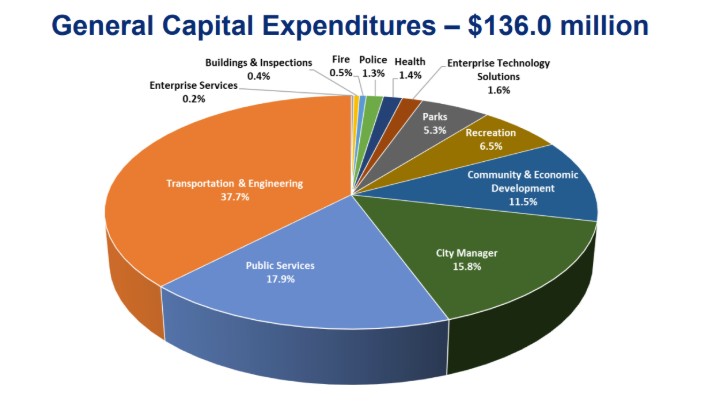
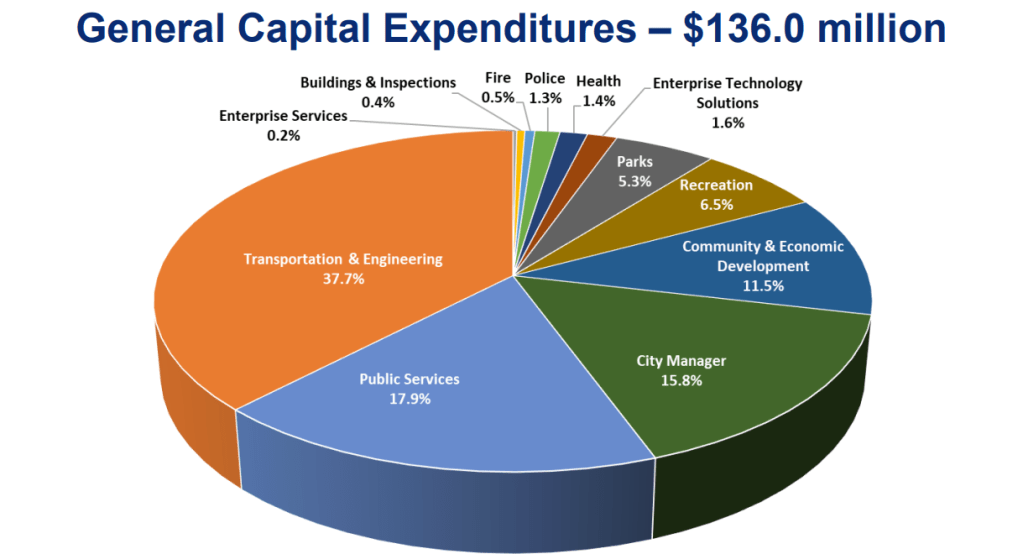
Cincy on Track is considered part of the city’s capital budget. In FY 2026, 72.6% of the capital budget went to Metropolitan Sewer District capital improvements; the general capital fund accounted for 19.2%.
How to get involved
The public always has a chance to weigh in on what the city is doing. There are public comment opportunities at the beginning of each City Council and related committee meetings.
The Budget and Finance Committee meets each Monday at 1 p.m. A schedule for all other council and committee meetings can be found here.