
Meeting summary:
- The Widening the Lens program creates a space for youth leadership in Cincinnati
- Withrow University High School students shared their experiences in the Widening the Lens program
- More youth-led spaces and programs could help mitigate juvenile crime in Cincinnati
Documenter’s follow-up question:
- Where can the public find more information about Widening the Lens?
- How will the City Council remove firearms from youth to ensure more safety?
- What are some spaces/programs youths can engage with to stay out of trouble?
Notes
Cincinnati City Council Meeting (Tuesday, Feb. 10, 2026) – Agenda
Meeting called to order at 12:30 p.m.
Meeting adjourned at 1:58 p.m.
Committee members in attendance:
- Committee Chair Anna Albi
- Vice Chair Evan Nolan
- Council Member Ryan James
- Vice Mayor Jan-Michele Lemon Kearney
- Administration: Director Tiffany Brown
- Law: Bryce Rhoades
- Clerk: Jeremy Barnes
Presentations:
Learning Grove Presentation and Widening the Lens Introduction
Elissa Yancy (A Picture’s Worth): Discussed Widening the Lens, a youth-led community conversation series that brings amazing students, adults and leaders from across Cincinnati to build relationships, shared experiences, and center youth voices as leadership. This work grew directly out of a United Way-supported effort called “Elevating Voices of Change,” which involves five other nonprofit organizations. Yancy said the organization is excited to support young people who are already shaping Cincinnati but who are too often talked about, instead of listened to. It also creates an opportunity for Black and Brown students to share their experiences.
Michelle Toney (Families FORWARD/Learning Grove): Discussed what makes Widening the Lens stand out is that it focuses on young people leading the space. They guide the conversations and decide what issues matter most to them. Adults don’t intervene as experts. This space invites adults to share responsibility while discussing community challenges.
Deanna White (Director of Human Services): Was one of 15 adults that listened to 15 Withrow scholars for six hours over the course of two months. White challenged adults to be fully present without formulating a response, without trying to defend, and without thinking about how they can fix the problem.
- Summary: They are meeting with the council because it is an opportunity for them to support more youth-led spaces that treat young people not as future leaders but as current leaders. Organizers say when council supports this type of work, they are investing in the trust and civic connection of a generation of young people who care about Cincinnati.
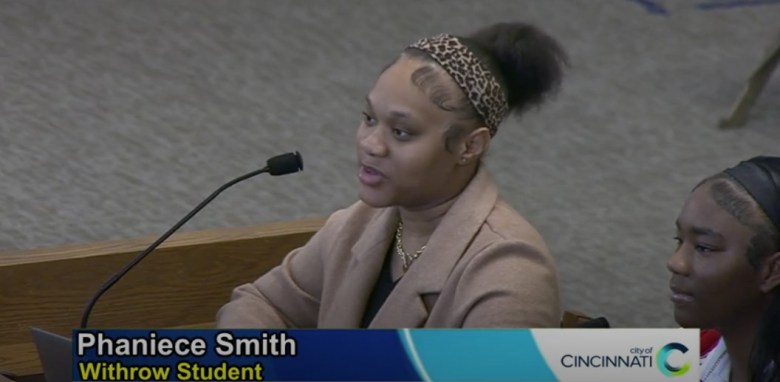
Phaniece Smith (Senior at Withrow High School): Discussed how safety in schools should be a focus for the community. Some students see school as their safe space away from home, she said, and she said there should be more after-school programs or activities.
J. Humphrey (Senior at Withrow High School): Discussed their experience with Cincinnati Metro as a student and accessing bus cards for transit. As a former Indiana resident, Humphrey was surprised to see fee increases for bus riders. Humphrey also wants to see more accessibility for students to ride the bus, especially if they don’t have anyone to take them to and from school.
Richard Thomas (Senior at Withrow High School): Discussed making the community safer because, as a young adult, Thomas can’t be in certain places at certain times of the day. He doesn’t want to be accused of being something he is not based on skin complexion or race.
Viccari Smith (Senior at Withrow High School): Discussed the time after completing high school. After attending two different schools, Smith detailed how, as an athlete, the schools don’t discuss anything outside of topics related to sports. Smith didn’t feel prepared for adulthood and said there are better ways to prepare students after graduating.
- Chairperson Anna Albi to Withrow students: What does the program look like for you?
Summary: The students said they all felt heard and that it was a great chance to learn from everyone’s experiences and personal obstacles. Humphrey said it was “all in all a great experience” because the students could build bonds with people they had never met. This furthered their knowledge on situations that they probably don’t talk to others about. For Humphrey, it felt like a “family bond without judgment.” Thomas and Viccari Smith also said that the program helped students talk to adults about topics they wouldn’t typically bring up with their parents.
- Vice Chair Evan Nolan: Reiterated that their campaigns and policies focus on the future of Cincinnati and how we can grow the city more equitably. Nolan has spent a lot of time at Cincinnati Public Schools (CPS) talking to students of varying ages on their outlook. Nolan asked: In your perspective, what obstacles do you see students facing?
Summary: The students discussed how some of their peers may feel uncomfortable talking about their feelings, largely due to a lack of mentorship/guidance and experience feeling listened to. Thomas said a lack of public speaking skills may discourage students from joining the organization. “Most people are scared to talk about what is going on in their daily lives.”
Viccari Smith said they can show students that it is OK to speak up about their feelings without embarrassment.
- Nolan asked a second question: What do job opportunities look like for youth?
Summary: There are a lot of job opportunities, such as working at a store or on a construction site, but working with adults can be difficult.
- Committee Member Jan-Michele Lemon Kearney asked: What are Men of MORE and JCG?
Summary: JCG (Jobs for Cincinnati Graduates) helps students obtain jobs. It helped one of the students, Humphrey, get a job opportunity at Kroger. It also aided in their financial literacy and opened up a lot of doors for students to figure out their future education and career endeavors.
Men of MORE (Men Organized, Respectful, and Educated) shows students how to hold themselves accountable and helps students get into the colleges of their dreams.
- Committee Member Ryan James encouraged them to run for City Council one day and asked: What is one thing we [council] should know about being a young person in Cincinnati?
Summary: Some students and youth overthink every choice they make, with Thomas exemplifying the fear of getting pulled over by the police and racially profiled. Other students said that youth mental health concerns are not acknowledged as much as they should be.
Observations: Each of the students shared a few things they love about themselves, where they will be attending college, and their extracurricular involvements. One of the goals of the committee is to break down silos between various government institutions that are interacting with children. All of the students were passionate about their personal experiences within the program.
Youth Defense in Hamilton County
Angela Yang (Director of Youth Defense Division and Hamilton County Defender): Has been in the
youth defense division for 10 years and spent time in the nonprofit world focusing on youth advocacy.
- Introduction of the Public Defenders Office
- Established in 1976; the commissions consist of five members
- Public defender attorneys (HPCD) are in their office, but a large chunk of the cases are handled by private attorneys who are court-appointed to represent the felony division.
- Public Defense Role
- Protect constitutional rights
- Hold government/police accountable
- Identify systemic issues
- Share community experience and voice.
- Youth Defenders
- In re Gault (1967): U.S Supreme Court recognizes that children in delinquency proceedings are entitled to certain procedural safeguards under the Due Process clause
- Hamilton County Public Defender Youth Defense Division: Holistic defense model: includes social workers, mitigation specialists and civil legal services
- Interdisciplinary Team for the Whole Child
- Includes educational advocacy, civil legal services, mental health/community supports (In one year, one-third of young clients with IEP or 5O4 plans, plus another 10% might need those services, resulting in 40% that are in the system that are not getting their needs met at school), and participatory defense.
- A child’s rights
- When a child’s liberty interests are at stake, he or she has a constitutional right to be represented by a lawyer. A child should get an attorney as early in the process as possible
- A child has a right to remain silent and should NOT speak to the police without an attorney present. The child must ask for a lawyer
- When a child’s liberty interests are at stake, he or she has a constitutional right to be represented by a lawyer. A child should get an attorney as early in the process as possible
- In Ohio, all children are considered indigent and eligible for public defense participation
- When a parent files a charge against their child, the court will require that the child have an attorney and guardian ad litem.
- Ohio Juvenile Court
- Anyone under 18 who is accused of a crime can be charged in juvenile court. It is meant to focus on what is best for the child and rehabilitation, but it may be punitive. Juvenile court records are not convictions, but they can still impact your future
- Harms of detention
- Detention can increase recidivism (explain). It is extremely ineffective and interrupts the natural process of maturing. It also increases risk of self-harm and exacerbates mental health issues, as well as interrupts education opportunities
- Disproportionately affects youth of color and youth with disabilities
- Alternatives to detention are more effective and less costly ways to reduce crime
- Special issues
- Competence to stand trial, false/involuntary confessions, complicity, felony murder, transfer adult court, racial profiling/racial disparities (80-90%), prison conditions, juvenile sex offender classification, and sealing/expungement
Observations: Yang provided suggested readings and a juvenile court cheat sheet
- Albi and Yang engaged in back-and-forth conversation regarding community engagement, common offenses, how to engage with upset community members, access to guns:
Summary (Community Engagement): Yang described how the division experimented with how they can engage with youth, including mandating curfews, with monthly meetings. There is currently a huge disconnect between troubled youth and safe programming/community involvement. Yang suggested that council could provide quicker mental health connections and more youth programs that steer kids in the right direction. More spaces for children to feel heard are also necessary, as well as making sure that programs are more accessible, available, and connect with children while they are struggling in school.
Summary (Common Offenses): Yang said school fights are disruptive, as is cussing out a teacher or throwing objects at people. The range of common offenses is large, including within special education.
Summary (How to engage with upset community members about not using detention as a method of prevention): Yang said that most car break-ins do not result in immediate harm, so sending people who commit them to court would be ineffective. Most kids age out of these behaviours as well. It’s more about refocusing on the underlying need instead of locking up a child.
Summary (Access to Guns): Yang said there’s a culture of using guns to protect oneself, so the solution is complex. Right now, adults should help students navigate how they can feel safe instead of lecturing them about how guns could hurt themselves and others.
- Nolan and Yang engaged in conversation about a minor’s rights when being detained:
Summary: Nolan said that If a minor has been arrested and taken to 2020 (refers to the address of the Hamilton County Juvenile Court), the temporary restraint cannot exceed the consequences of being found to have committed the offense. In that moment, if a teen is brought to 2020 and has broken into a car, and is deemed to not be a risk of imminent harm or danger, state law requires that they be released. Research shows that it is in the better interest of the community if they are not detained. Many of the alleged crimes amongst youth are with youth, so it’s hard to ask a young person to disengage with that environment. It is important to help them share their experiences to redirect their choices.
Motions:
- Submitted by Council Members Albi and Jeffreys
- Committee moved forward a motion that the administration will prepare a report within 30 days assessing the need for additional lighting and camera infrastructure across city parks, playgrounds and recreational areas owned by Cincinnati Parks and the Cincinnati Recreation Commission, with priority given to locations that have already experienced shootings and the five neighborhoods experiencing the highest levels of gun violence.
- They also passed a motion that the administration will prepare a separate subsequent report within 30 days of the initial report outlining the City of Cincinnati costs associated with installing, operating and maintaining recommended lighting and camera improvements identified in the initial report, including any potential funding sources.
If you believe anything in these notes is inaccurate, please email us at documenters@signalcincinnati.org with “Correction Request” in the subject line.
Find more Documenters’ notes here.