
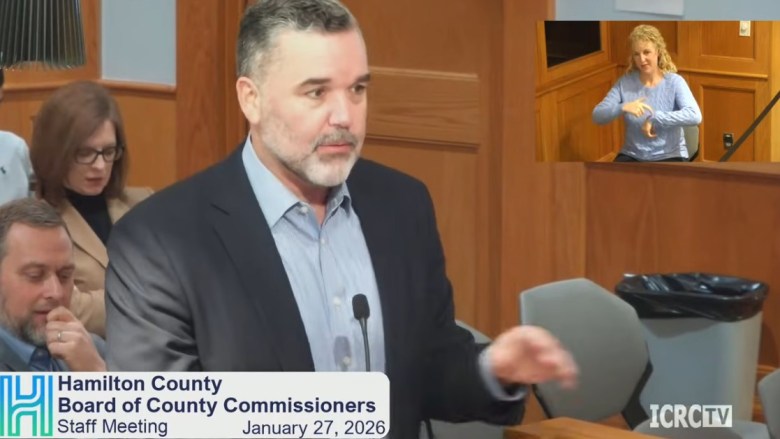
Meeting summary:
- Traffic safety is improving in Cincinnati.
- Youth sports accessibility is important to city officials.
- A safer youth sports program for all involved is being explored.
Documenter’s follow-up question:
- What is the county doing to market tiny homes in Greater Cincinnati?
Notes
Scene
The meeting was held, as it is normally, in Room 603 at the Todd B. Portune Center for County Government, 138 E. Court St., in downtown Cincinnati. Spectators and presenters were in attendance, as were two of the three commissioners, an assistant county prosecutor, county administrator, assistant commission clerk and chief clerk. The commission’s YouTube feed began at approximately 10:02 a.m. The commissioners adjourned the public portion of the meeting at 11:20 a.m. and went into executive session, which adjourned at 11:37 a.m.
Commissioners present
- Stephanie Summerow Dumas, president
- Denise Driehaus, vice president
Alicia Reece, commissioner(excused)- Jeff Aluotto, county administrator
- Patrick Dressing, county prosecuting attorney’s office
Approximate time spent during the meeting
- 15 minutes: Health Update
- 44 minutes: Affordable Housing Update
- 19 minutes: Sewer Back Up Strategic Reduction Risk Initiative
- 14 minutes: Executive Session
Agenda
The agenda featured four items:
ITEM 1. Health Update
There is a downward trend in influenza cases in Southwest Ohio (which includes Hamilton County), county Health Commissioner Greg Kesterman said in providing an update on flu in 2025-26.
There have been 931 reported hospitalizations in Southwest Ohio (302 in the last week of December) according to the Ohio Disease Reporting System, which means this season has been “a very drastic influenza season in regards to hospitalizations,” Kesterman said. The respiratory season typically is September through mid-May.
During the same period, reported pneumonia- and influenza-related deaths have been 30% lower than the five-year average, according to reporting done statewide, he said.
Flu this season has been virulent and has been spreading “super easy,” he said.
The department is now using wastewater monitoring of the Little Miami River and the Mill Creek (the area’s two largest watersheds) as a tool to help understand what’s going on in communities, he said. It’s also a tool MSD can use to understand whether industrial pollutants are getting into wastewater. Summit County officials are monitoring wastewater for illicit drugs such as amphetamines and fentanyl.
The health department still encourages flu and childhood vaccinations, Kesterman said, suggesting that people speak with their health care and insurance providers. “Most families are choosing to get vaccinated, from what we’re seeing,” he said.
About the status of COVID-19 in the community, Kesterman said the health department is not seeing the tracking seen five years ago where people were reporting test results, but he added, “We know, according to past tracking, that spikes have been seen in August and in January.” The department won’t be surprised if another spike is seen in early February because of the lack of a spike in January, he said, but the department has not seen hospital numbers that would indicate that this would be a significant year for COVID.
Reporting of childhood vaccinations is not mandatory, he said, but there have been some lower childhood vaccination rates for key childhood immunizations, which is not great news when you hear about cases of measles, he said.
ITEM 2. Affordable Housing Update
Hamilton County is to be lauded for its investment to create and preserve affordable housing and should continue its partnership with the Cincinnati Development Fund (CDF) to communicate with areas outside Cincinnati that oppose affordable housing because of perceptions about the term.
“It’s worth saying that this has been a successful program,” Luke Blocher, CDF general counsel and chief strategy officer, told commissioners, explaining that the CDF is “a bridge between funder and builder to make such projects work.” The CDF does this by making loans and granting subsidies.
The county American Rescue Plan Act (ARPA) has met the moment, he said, noting, “We have to figure out how to keep it going.”
The county has invested about $29.3 million in ARPA funds across 30 projects (more than $344 million in total public and private investment), Blocher said, and has created 1,088 housing units in the three-year partnership with the CDF (229 affordable housing units preserved, 859 affordable housing units created).
The county ARPA plan’s initial goal was 750 housing units, according to his presentation. It was set up to focus on geographic diversity, work with smaller real estate developers, develop housing for residents at a range of incomes, extend the program outside Cincinnati and encourage development of tiny homes.
Three of the most successful CDF-county ARPA projects include the renovation of the Alexandria Apartments in Walnut Hills (a senior living facility that has been given 30 additional years of life because of the refurbishment), LADD (Living Arrangements for the Developmentally Disabled) and the Pedretti Place senior living complex in Delhi Township.
The county has $5.33 million in uncommitted dollars remaining in its housing unit program (including $1 million for tiny homes and $3.6 million for projects outside Cincinnati). Those dollars have to be deployed into projects by the end of the year, Blocher said (the CDF’s fiscal year ends March 31). CDF is cautiously optimistic that the Tiny Homes for Humanity project will work, he said. An application has been received, and issues involving zoning, building permits and funding are still being worked out.
“We’re going to do everything we can to make that happen,” he said.
Blocher said CDF is meeting with the Cincinnati Metropolitan Housing Authority (CMHA) this week to discuss CMHA’s $2 million affordable housing plan. CMHA was working on a tiny homes project, but it didn’t work out because of HUD requirements that included having the developer pay the market rate for land dedicated for the tiny home.
There has to be land donated for this to work, Blocher said of the tiny home project, noting, “We’re glad CMHA made the effort.”
Blocher confirmed Driehaus’ concern that some plans for affordable housing outside Cincinnati have not moved forward because not every one of the county’s 49 jurisdictions has wanted the projects. Blocher said there are a number of single-family homes outside the city versus inside the city (60% to 40% estimated), but uncertainties about community engagement, township zoning rules and laws are some reasons why some developers have been reluctant to build outside Cincinnati.
A lot of people, when they hear the term affordable housing, think rundown properties at the bottom of the market that are poorly managed, Blocher said. He called for more conversation with community leaders.
“There’s work to be done there,” he said, in softening opposition or unease about affordable housing.
Blocher said CDF has a late April deadline to determine the status of housing projects in its pipeline.
ITEM 3. SBU Strategic Reduction Risk Initiatives
Reese Johnson, deputy director and chief engineer, Metropolitan Sewer District of Greater Cincinnati, said MSD, with the commission’s support, wants to expand its Sewer Backup (SBU) program to prevent backups before they happen.
SBUs, the backup of the public sewer into a home or business, are caused by inadequate capacity in the sewer. The SBU program assists property owners as a required part of MSD’s federal consent decree. MSD’s current SBU program is reactionary, he said.
SBUs in MSD’s service are widespread but clustered. There are 474 clusters in the service area, connected by hydraulics. MSD is tracking 200 Low Recurrence Interval SBU Areas. For example, Sharonville has a project to develop 327+ apartments. MSD could build miles and miles of new sewers, increase stormwater storage capacity, or partner with a municipality via an intergovernmental agreement (IGA).
The IGA would include a short-term adequate capacity (STAC) program. Here’s how it would work: MSD identifies confirmed sources of private-side sewers exceeding 42,000 gallons per day in their municipality. Sharonville removes 42,000 gallons per day from private property (Sharonville anticipates a grant program to help residents). The city would hold credits in a public pool, then be rewarded those credits once MSD confirms the removals. When a downspout is removed, for example, the municipality is credited 1:1 public to private.
Next Steps
* The county commission approves the IGA at its business session this week
* MSD continues discussions with municipalities on upcoming projects (Springdale and Blue Ash)
* MSD engages in broader outreach to other municipalities about the program
Impervious surfaces are not included in the SBU program, and Johnson said he’s not sure why. Impervious surfaces are disconnected from the sewer system.
Communities are adding financial incentives – grants and other sources – to help reduce sewer backups, he said.
Driehaus said she is thrilled with the preventative focus of MSD’s initiative. “I just think it’s a great idea. We talk a lot about prevention. And here we are.”
ITEM 4. Executive Session
The public portion of the meeting adjourned at 11:20 a.m. Commissioners moved into executive session at that point to discuss “the sale of acquisition of property.” That session adjourned at 11:37 a.m.
Public Comment: There was none.
If you believe anything in these notes is inaccurate, please email us at documenters@signalcincinnati.org with “Correction Request” in the subject line.
Find more Documenters’ notes here.