
Meeting summary:
- Public commenters responded to a hearing on the recommended Hamilton County 2026 budget. County Administrator Jeff Alluoto presented the proposal, which includes a real estate transfer tax increase to cover the rising costs of existing county programs and services. Departmental budget requests exceed the 2026 projected revenue, while cuts at the federal level strain local services.
- Commissioners voted 2-1 to use 4.5% of the Riverfront Sales Tax Fund revenue for a property tax rebate (PTR), falling short of the promise of an annual 30% PTR. Commissioner Reece voted against the resolution and has launched an online petition for a 30% PTR in 2026.
- The Hamilton County Public Defender is seeking additional funding in light of the increased expenditures on law enforcement and surveillance technology to prevent government overreach and unjust convictions.
Documenter’s follow-up question:
- What happens if Hamilton County becomes unable to pay their debt to the Bengals? Will the county need to declare bankruptcy or become unable to pay for essential services? Are there any options available for Hamilton County to amend or exit the lease agreement?
- How will Hamilton County residents experience the impact of a tightening county budget amid federal cuts and rising costs of public services? What services will be cut if the transfer tax increase is not approved?
Notes
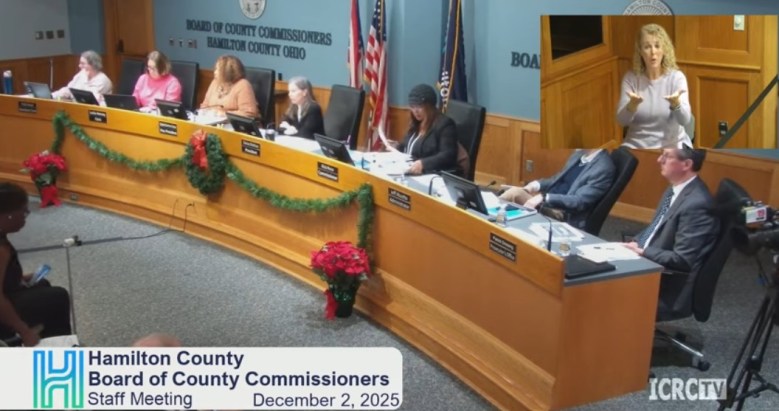
This meeting was documented via this recording.
Board of County Commissioners President Denise Driehaus called the Dec. 2, 2025, Commissioners Staff Meeting to order at 10:05 a.m. with the following in attendance:
- Denise Driehaus (president)
- Stephanie Summerow Dumas (vice president)
- Alicia Reece (commissioner)
- Jeff Aluotto (administrator)
- Patrick Dressing (assistant prosecuting attorney)
- Leslie Hervey (clerk)
- Kristie Rechel (assistant clerk)
Item 1: Proclamation recognizing LISC Greater Cincinnati [7:35]
Commissioners read the full text of a proclamation to name Dec. 3, 2025, as LISC Greater Cincinnati Day to recognize the 25th anniversary of the Local Initiatives Support Corp. (LISC) of Greater Cincinnati.
Item 2: Proclamation honoring Michael Patton upon his retirement from Hamilton County Job and Family Services [13:33]
The commission proclaimed Dec. 2, 2025, as Michael Patton Day to honor Patton, the first African American to serve as director of Hamilton County Job and Family Services, in recognition of his 32 years of service on the occasion of his retirement.
Reece emphasized the importance of Patton’s success and self-presentation to inspire the Black men whom he has served. Patton, through tears, thanked the commission and people who had supported him for the honor of the recognition and opportunity to serve.
Item 3: Hamilton County 2026 Budget Hearing [28:32]
Aluotto presented the recommended 2026 budget, on which the board has yet to act. The 2026 All Funds Budget totals $1.375 billion, which includes the $402.4 million General Fund Budget. The budget is 3.3% higher than last year, but Aluotto said that revenue growth has flattened.
Departmental budget requests exceeded projected revenue, despite only “modest” increases from last year’s departmental budgets. Aluotto said that requests were generally not for new programs, but “to do those things that departments and elected officials in the county feel are necessary to accomplish the basic mandated services of county government,” such as operating courts, jails and elections.
The budget recommends one new revenue source: a one mill increase to the Transfer Tax, expected to generate $4.7 million. Aluotto recommends that $3.7 million “go to support general and mandated functions of the county” and the remaining $1 million go “annually to support a county contribution to affordable housing efforts in the county.”
Aluotto said the board will have its first opportunity to pass the budget Dec. 11, 2025, but has set Dec. 18 as the target date to have the budget resolved.
Public Comments
(Comment summaries are organized by topic rather than chronologically; refer to the timestamp indicated with each speaker.)
…on funding the Hamilton County Prosecutor
Defense attorney Kathleen Brinkman [39:15] and Ohio Justice and Policy Center CEO Gabe Davis [51:07] urged the commission to fund the County Prosecutor’s Conviction Integrity Unit. They said the purpose of the CIU is to protect civil rights and equity by preventing wrongful conviction and unfair punishment. Brinkman also said that County Prosecutor Connie Pillach needs adequate funding in order for staff to have manageable caseloads and adequate training “to ensure that police investigations and county prosecutions are thorough, lawful and ethical.”
…on funding for community programs
Women Helping Women President and CEO Kristin Shrimplin [47:20] said that the county should continue to fund the Domestic Violence Enhanced Response Team (DVERT) program. Shrimplin said that funding DVERT “is not just important, it’s lifesaving.”
Artworks Board Treasurer and Vice Chair Jens Rosenkrantz [41:53] said that the organization is important for “creative workforce development” and should continue to receive county funding as nonprofits are facing “unprecedented challenges.”
LaTonya Chichester [43:23] and Tiffany Tucker [49:39] of the Urban League of Greater Southwestern Ohio asked the commission to provide $200,000 in administrative grant support to Building Futures. Chichester said Building Futures is “a pre-apprenticeship program designed to prepare individuals for high-demand, high-wage careers in the construction trades.”
Blink Executive Director Leslie Mooney [45:42] and Co-founder Andrew Salzbrun [53:17] continue to fund the $1.25 million Large Tourism Event Grant in support of the biannual public art and lighting festival.
…on property tax increases and rebates
Representatives from the Realtor Alliance of Greater Cincinnati, including President-elect Jason Kunkel [55:40], Advocacy Committee Chair Heather Kopf [57:33], and Board of Directors President DeVan Gassett [1:04:20], spoke in support of a full 30% Property Tax Rebate in 2026 and in opposition of a proposed transfer tax increase.
Gassett said that recent property tax increases have “pushed many families to the edge of affordability.” Kunkel said the proposed 4.5% PTR “effectively breaks a 30-year promise and forces homeowners to absorb the consequences of budget pressures they did not create.”
A lower rebate coupled with the transfer tax increase “will limit mobility, discourage downsizing, and deter new buyers entering the market,” Kunkel said. Kopf said that it is important to the local economy for homeowners to have disposable income.
The commissioners debated property tax rebate later in the meeting (see item 4).
…on changes to Metropolitan Sewer District billing
Larry Falkin [1:00:50], a member of the Sierra Club Miami Group Executive Committee, spoke on Zoom to encourage the Metropolitan Sewer District (MSD) of Greater Cincinnati to charge a fee to owners of properties with large impervious surfaces, like parking lots, which cause runoff. Falkin said the measure does not appear in the proposed 2026 MSD budget, but Hamilton County Commissioners have previously considered an impervious surface runoff charge. The Sierra Club Miami Group has endorsed the proposal, Falkin said.
The Sierra Club Miami Group and Communities United for Action (CUFA) encouraged public comment in support of sewage rate reform.
See item 7 for further discussion of MSD rates.
Item 4: 2026 Property Tax Rebate consideration and Resolution Authorizing a Property Tax Rebate for Calendar year 2026 [1:08:00]
Aluotto presented the recommendation for the 2026 Property Tax Rebate (PTR). The PTR is funded through the Riverfront Sales Tax Fund, which also contributes to the construction and operation of stadiums and to Cincinnati Public Schools. Aluotto said a “full PTR” refers to allocating 30% of the annual sales tax revenue in the Riverfront Sales Tax Fund toward PTR, not a 30% credit of a household property tax bill.
The county provided a full PTR last year, but providing “a full PTR in 2026 would essentially eliminate the fund’s reserve,” Aluotto said.
The administration is recommending a 4.5% PTR in 2026, which the Enquirer reported will be the lowest since the program began. Providing a full PTR last year brought the balance of the Riverfront Sales Tax Fund to a record low. The balance is now “substantively below” the amount that the board previously determined constitutes an “adequate reserve,” Aluotto said.
The county agreed in June, as part of the new 11-year lease agreement with the Cincinnati Bengals, to pay for 75% of a planned Paycor Stadium renovation. The county plans to issue bonds to cover its $350 million commitment. Using the Riverfront Sales Tax Fund will allow the county to issue the bonds sooner, which Aluotto said would help the county to pay its debt sooner and avoid costly interest.
“Our primary concern has been ensuring that the county’s General Fund, which pays for sheriff’s deputies, election workers, 911 operators, does not necessarily need to support the operations of Paycor Stadium or Great American Ballpark, especially when the General Fund is as strained as it is,” Aluotto said.
“We are all living under this burden of a promise that we did not make,” Driehaus said of the 30% PTR commitment. “Our predecessors made it. It was irresponsible then and it is irresponsible now.”
Driehaus said the county cannot afford to provide property tax relief and must depend on state funding. Driehaus was a member of the Ohio Property Tax Working Group that generated 20 recommendations to help homeowners after a 2023 property reappraisal triggered hefty property tax increases.
HB 335 contains the only recommendation of the original 20 to pass the Statehouse, Driehaus said. If Gov. Mike DeWine signs the bill into law, it would cap the growth of the county’s inside millage to the rate of inflation. Driehaus supports the measure but said it will “limit our capacity to grow our revenue in that fund.”
“I don’t know why we can say ‘the Bengals lease was terrible, the worst lease ever, but that part that has the 30% PTR in there, that’s great,’” Summerow Dumas said. “What they did, it was a setup, to try to have the new board confined to that 30% without looking at the landscape of where we were financially.”
Summerow Dumas said funding for essential services is tight across the board.
Reece said that she missed the previous BOCC staff meeting, when the proposal was first presented, because she “had to be rushed into emergency surgery.” Reece said she had remained hospitalized for over a week and was defying doctors’ orders to attend the present meeting.
Reece suggested that the county has been hypocritical by saying they need to keep the commitments made to the Cincinnati Bengals while calling it “irresponsible” to provide the annual 30% PTR promised to homeowners. Reece cited an article that said the county’s new lease agreement with the Bengals was a factor in the decreased property tax rebate.
“If it was irresponsible to give a commitment to the homeowners then it was an irresponsible commitment to give to the stadiums,” Reece said, adding that other NFL teams have paid for their own stadiums.
“We folded too fast and we left out the taxpayers,” Reece said.
Reece filed a motion to adopt a resolution supporting a full 30% PTR and to “remove any proposed increases to the real estate transfer tax” from the proposed 2026 budget. She also created an online petition in support of a full PTR.
Commissioners Driehaus and Summerow Dumas voted to approve 4.5% PTR; Reece voted against. Reece left the meeting after the vote.
Item 5: Public Defender 2026 Budget Presentation [1:49:28]
Angela Chang, director of the Youth Defense Division, presented on behalf of the Hamilton County Public Defender. Planned co-presenter Sean Vincente was absent due to traffic.
The presentation argued that public defense is an important part of public safety. As Cincinnati and Hamilton County increase surveillance technology and police funding, Chang said that public defense is necessary to “ensure that the government is not overstepping and violating constitutional rights” and to prevent unjust arrests and convictions.
When public defenders win cases, “we are making sure judges know that a person has a plan and is safe to return to the community so we don’t have to spend the dollars on incarcerating them,” Chang said, resulting in hundreds of thousands of dollars in savings.
The Public Defender is asking for full funding of their departmental budget request in order to retain “top talent” and provide training on new laws and law enforcement technology.
Provision of public defense is mandated at the state level. Counties are eligible for state funding to reimburse county expenditures for county defense, though Driehaus implied that the reimbursement has not been reliable.
“I will continue to advocate, by the way, for the full reimbursement from the state,” Driehaus said. “We just heard earlier about the state simply not holding up their end of the bargain and this is another example of that. We are doing a service for the state, they are mandated to do it, we do it for them, and they don’t pay us for it.”
Item 6: JFS 2026 Budget Presentation [2:13:11]
Patton presented the proposed 2026 Job and Family Services (JFS) budget. Most of the funding for JFS comes from the state and federal levels, Patton said. Funding at the county level comes from the child services levy that will be up for renewal next year.
JFS operations, which include children’s services, food assistance, workforce development and Medicaid support, stand to take a hit from funding cuts legislated in the One Big Beautiful Bill (OBBB). OBBB also doubles the frequency of required Medicaid recertifications, which “essentially doubles” the workload for JFS caseworkers, Patton said. Caseworkers will also have to monitor compliance with new work requirements for Medicaid recipients.
As the cost of providing care also increases, “the starting point [for budget consideration] will certainly be for us to look at what the levy is funding that is not mandated [by the Ohio Revised Code] at this point, and also what the implication would be if there were reduced levy funds in the general fund going forward, with OBB[B] in the background,” Patton said.
The Women Helping Women DVERT program is one example of a “really important” but non-mandated service that the county funds, Driehaus said. She added later, “One might argue that some of the services that we do that are non-mandated prevent kids and adults from going into the system in the first place.”
Summerow Dumas said the county should explore grant funding for some programs.
Item 7: MSD 2026 Budget Hearing [2:44:47]
Diana Christy, director of the Metropolitan Sewer District (MSD) of Greater Cincinnati, presented the department’s budget at a previous meeting and received public comment.
Christy said the moderate budget request increase over last year reflects inflation and rising costs that are mostly “out of our control.” It is getting more expensive to maintain aging sewer infrastructure, Christy said, until funding for capital improvements becomes available. MSD is making progress through the Wet Weather Improvement Program to bring water infrastructure up to compliance with the Clean Water Act as two federal consent decrees mandate. Christy said that the improvements are “very costly” and are funded entirely at the local level.
All customers pay for a share of the cost of infill and infiltration (I/I), or water that enters the system from unmetered sources, like runoff. MSD plans to amend its billing structure to eliminate the “declining block rate, or high-volume user discount.” Christy said the change will make for a more equitable distribution of I/I costs while increasing revenue about 4.5% to cover capital improvements. Most residential customers will see either no change or a “modest decrease” to their sewer bill, while industrial and commercial customers will pay more.
Adjournment
The meeting adjourned at 1:09 p.m. Items 8-10, including a “Coalition Letter of Opposition to the Transfer Tax Increase and the Property Tax Rebate” and the “Property Tax Relief Motion” that Reece had introduced during the meeting were filed to the record.
If you believe anything in these notes is inaccurate, please email us at documenters@signalcincinnati.org with “Correction Request” in the subject line.
Find more Documenters’ notes on Cincinnati City Council here.