
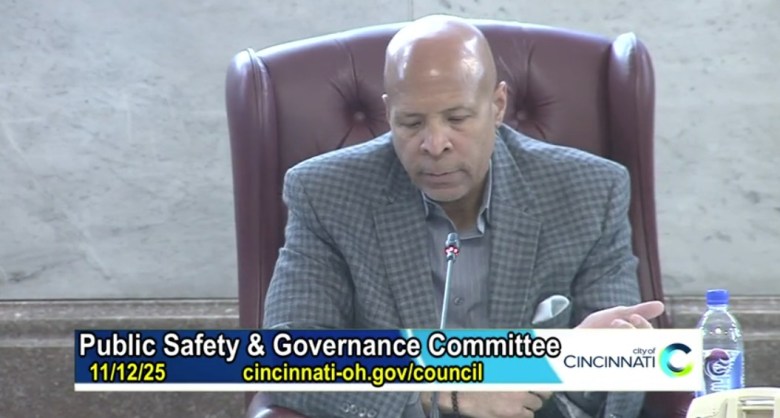
Meeting summary:
- Council members and food truck owners are unhappy with the new restrictions on food trucks, in particular the 11 p.m. curfew.
- While Cincinnati police believe there is crime associated with food truck locations, at this point it is unable to demonstrate the problem, or its source, with ample data.
- Curfew for juveniles under 18 will be enforced in a narrow special district on Short Vine in an attempt to curb disorder in the area. Cincinnati police are working on this in conjunction with the University of Cincinnati Police Department.
Documenter’s follow-up question:
- Are food trucks causing an issue with disorder and crime or is there only a correlation here, not causation?
- How can city youth be better supported and engaged so that they are less likely to get into disorderly incidents?
Notes
Officials in attendance:
Council Member Scotty Johnson, Vice Mayor Jan-Michele Kearney (chair), Council Member Mark Jeffreys (vice chair), Council Member Anna Albi
Food truck curfew discussion
Scotty Johnson opened the meeting at 9:33 a.m.. He noted that there were no in-person speakers for public comment at this meeting. Two had signed up for comment on Zoom but were not present. Johnson noted that Amy Flottemesch, president of the Cincinnati Food Truck Association (CFTA), had planned to comment but was not yet present.
The first item on the agenda was a presentation on crime within food truck zones. Assistant City Manager John Brazina introduced Jillian Desmond, senior crime analyst, and Captain David Schofield, Central Business Section commander.
Desmond began the presentation with an overview of some of the challenges surrounding the process. She emphasized how much their information relied on conversations with officers about their experiences with crime around food truck vendor locations. Food trucks are not assigned locations and can move anytime
Desmond said they were concerned with generalized disorder, fighting and crowds, but this measurement is broad.
“It’s really difficult to capture some of the problem itself with data, so it really heavily relies on … the officers on the ground seeing and describing what they see every day,” Desmond explained.
The data that they do have is calls for service. Desmond clarified these are all logged calls, including between officers and dispatch – not necessarily people calling the police for assistance.
Jennifer and brad bradley.adkins@encoreglobal.com
In addition to general disorder, the second issue is a strain on resources. A typical patrol area might have peak hours with high need, but these areas see a consistently high need for service. She defined the term Code Zerot, which means that something is needed and no one is available to answer. It seemed this was another indicator she was tracking in the data.
Desmond said that unlike restaurants, food truck vendors do not supervise their own dining area. This leaves the issue to the police. Also, people tend to congregate outside bars, and once the bars let out of the night it is heightened.
Schofield spoke about his experience and his conversations with officers. Since the implementation of the current restrictions, there have been less calls for officers, less disorderly conduct.
Demond explained that they have increased restrictions and enforcement on three issues: 1) heavier parking restriction enforcement; 2) restricting hours of operation of food trucks, and 3) restricting proximity to liquor establishments.
So far, this has resulted in an increase in citations and warnings given to food truck operators. This has only been in place for a couple of months, so data is very preliminary, and seems to have only had a small effect so far, she said.
Flottemesch appeared on the Zoom call and joined the meeting. She said she represents nearly 100 food trucks and advocates for the industry as a whole.
She emphasized her desire for a positive relationship with the city to work in partnership for public safety. Currently, the new restrictions have been problematic for members, with clear profit losses due to having to park in less lucrative locations. The food truck curfew limits their ability to work at large events or even being booked for special events.
Additionally, new restrictions also include additional fees. She would like to have better communication with the city and for food truck owners to have a voice in the conversation. She also noted that she has previously offered a presentation on solutions that have worked in other cities, such as in Columbus in partnership with the Central Ohio Food Truck Association.
Johnson thanked Flottemesch and asked Brazina if his office could coordinate with her. It appeared that there had been some miscommunication and possibly Brazina had the wrong email address for Flottamesch, as the office had already reached out to her but received no response. They agreed to find a time in the next couple of weeks.
Kearney read some concerns that Flottemesch had sent to the city manager’s office in an email.The email included some of what she had already discussed, but also the claim that businesses were losing about $3,000 to $9,000 in profit per week, which was a major concern to food truck owners ahead of their typical dip in business in winter. Kearney said she wanted to hold off on this vote about revisions to the municipal code’s food truck ordinance until the city manager’s office has met with Flottemesch and CFTA.
Council members Anna Albi and Mark Jeffreys had additional questions and it became clear that, as Desmond said at the beginning of the presentation, the understanding of the problem is based more on officer experiences and increased call volume rather than specific food trucks.
Albi said the problem might have more to do with bars than with the food trucks, and was very concerned with the way that these restrictions hurt small business owners. In response, Johnson said police opinions are important, and they need to feel supported in making the city safe.
There was discussion about whether the current curfew should remain in place at all. Albi said she was struggling with the idea of keeping the curfew in place when there seems to be so much more research to do. She raised a motion to lift the curfew and reassess it. Jeffreys seconded her, and Johnson asked if there should be a roll call vote. Jeffreys reiterated that although he appreciates the anecdotal aspect, the data doesn’t support maintaining the curfew, and he would like to pull it back and regroup so as not to penalize small business owners.
There was a brief discussion with the city solicitor about whether the motion was to repeal the ordinance. The solicitor explained that it is not yet in place, so it would not need to be repealed.
There was a call to vote, Johnson and Kearney said no, Jeffries and Albi voted yes. The motion failed.
Short Vine youth curfew
Johnson called up Cincinnati Police Lt. Col. Matthew Hammer and University of Cincinnati Police (UCPD) Chief Eliot Isaac to be seated next to Brazina to present an emergency ordinance to modify city municipal code to create a new extended curfew district in the Short Vine area of Corryville to better address juvenile crime and support juvenile safety in Cincinnati. This would mean a 9 p.m. curfew for those under 18 in the Short Vine area between Corry Street and Daniels Street.
Hammer explained that due to a rise in disorder in the area, they have already implemented a number of responses, such as parking restrictions and flexing additional resources to the area. He said CPD District 4 has long worked with UCPD for public safety in the area. He mentioned some of the resources that UC adds to the area, including leasing a building of a former liquor store in the area for police use as well as a bicycle kitchen. He advocated for the curfew as an additional tool for this purpose.
Jeffreys agreed that it is a big problem in the area right now, and business owners are saying it’s the worst it’s been in 30 years. He requested updates on how the curfew is being enforced. Brazina said four juveniles had been taken to the curfew center of the past few months.
Jeffreys wanted to know why these two blocks are having this issue, wondering if the curfew is implemented, if children would just relocate to another area. He also said it doesn’t seem like a curfew will help address some of the violent crimes that have happened after midnight.
Hammer said he wasn’t sure why it is occurring here, but he feels there are some commonalities between Designated Outdoor Refreshment Areas (DORAs), Main Street and Short Vine. He agreed that a curfew might not address those late night incidents, but that there is a spike at 10 p.m. in the area that is drawing CPD resources. Isaac pointed out the specific issue here is the number of juveniles in this crowd.
Kearney and Albi had some follow-up questions about penalties and enforcement. The first penalty is just a curfew violation, and then the second time is a misdemeanor for child and parent. Isaac explained that sometimes it’s as simple as saying to the kids “hey, 10 minutes to curfew,” in order to clear them out.
The chair announced that Item 1 would be filed, they would hold on Item 2, and Item 3 would be put on for passage.
The meeting was adjourned at 10:57 a.m.
These notes can be found on documenters.org.
If you believe anything in these notes is inaccurate, please email us at documenters@signalcincinnati.org with “Correction Request” in the subject line.
Find more Documenters’ notes on Cincinnati City Council here.