
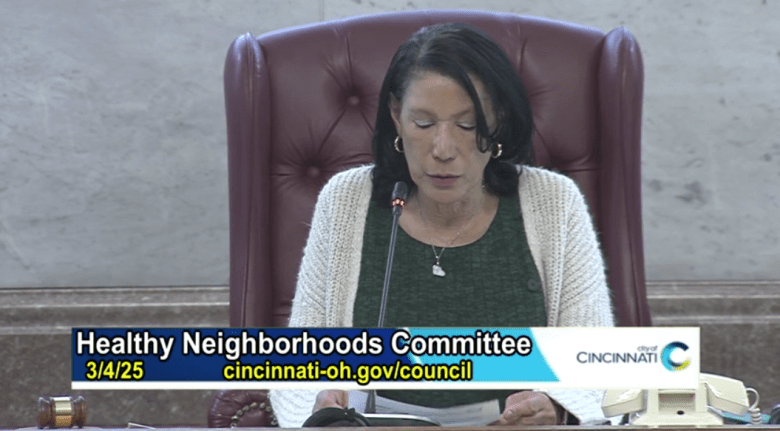
Meeting summary:
- The presentation by the A1 Stigma Free Coalition highlighted the racial disparities in substance use treatment and harm reduction efforts.
- The Cincinnati Minority Cannabis Education Coalition proposed a harm reduction-focused community panel discussion on the impact of cannabis legalization on youth.
- There was a discussion on creating an LGBTQIA+ Commission to ensure Cincinnati remains a sanctuary city and better protects vulnerable community members.
- Emergency ordinances introduced for honorary street naming in recognition of community contributions.
Documenter’s follow-up questions:
- For the LGBTQIA+ Commission proposal: What specific policy recommendations are they looking to prioritize in its first year, and how will community input be integrated into deciding policy recommendations?
- For the A1 Stigma Free Coalition: What specific partnerships or funding sources will you pursue to expand harm reduction services and outreach in Cincinnati’s Black communities?
- For the Cincinnati Minority Cannabis Education Coalition: How does the coalition plan to measure the long-term impact of its prevention and harm reduction efforts on youth cannabis use in Cincinnati?
Committee Chair Jan Michele Lemon-Kearney opened the meeting at 12:33 pm.
Attendance
- Vice Mayor Jan-Michele Lemon Kearney (Co-chair, presiding)
- Scotty Johnson (Council Member)
- Anna Albi (Council Member)
- Lisa Carrion (Clerk of Council)
- Ian Doy (Legal Office)
- Gerald Fortson (Department of Community & Economic Development)
- Steve Sobel (Citicable)
Public Comments
Jonah Yokoyama:
- Advocated for Cincinnati to become an official sanctuary city for LGBTQ+ individuals.
- Emphasized rising violence and legislative attacks on LGBTQ+ people.
- Suggested the establishment of a formal City Commission to safeguard community interests.
- Shared experience as a nurse working with transgender individuals, reporting a high rate of suicide and murder within the community.
- Stressed the need for representation in city decision-making.
Presentation 1: A1 Stigma Free Coalition
Monte Burnett, founder of A1 Stigma Free Coalition
- Burnett: A1 Stigma was birthed in Avondale at Living God Church. The African American Engagement Workgroup (AAEW) came to the church and informed them of high overdose death rates in the African American community. Churches are getting involved because the numbers in deaths in African American communities are increasing as Hamilton County overdose deaths are decreasing in general. Community members do not reach out for help because of fear with stigma. There’s a need for services to assist with serving or providing assistance to community members. Offers boots on the ground services to be close to community members it serves.
Michael Collins, chief operating officer (COO), Reach One Recovery Services
- Substance use statistics: Black and white individuals use illicit drugs at similar rates (21.9% vs. 21.7%).
- Black individuals are 18-37% less likely to complete treatment due to stigma and systemic barriers.
- There are higher rates of STIs and overdose deaths in Black communities.
Rashida Pearson, Community Outreach Expert, Walls of Wellness
- Advocated for harm reduction strategies, including syringe exchange programs.
- Emphasized cultural stigma around drug use in Black communities, limiting access to support.
- Requested collaboration with the city to raise awareness.
- Wants to get into the schools to educate against culture promoting drug-use to children, “looking to become community partners with City of Cincinnati to elevate information”
- Vice Mayor Jan Michele Lemon Kearney noted an upcoming meeting with Cincinnati Public Schools (CPS) in mid-April to discuss prevention efforts.
Launie Miller, Mental Health & Substance Use Therapist, Peaceful Intentions Counseling & Education
- Owner of Peaceful Intentions, counsel and consulting.
- Discussed the link between mental health and substance use.
- “Mental health is anything that affects us psychologically, emotionally and physically and our behavior and language.”
- Mental health and substance use are connected through trauma. It helps people cope with external circumstances. Both have to be treated to provide someone holistic care and resources to address the root of their problems. When someone is using, mental health is important.
Todd Craig, Court Liaison & Education Counselor, DeCoach Recovery Centre
- In the city of Cincinnati, court liaisons from community agencies are available, creating connections with judges, defense attorneys, prosecutors, and the probation department. These liaisons play a crucial role in cases that are drug-related or a result of drug use. They work to mitigate these cases to treatment programs within the community justice system. “There’s more help now than there has ever been in regard to addiction treatment, and it’s still not enough.”
- Stressed the need for expanded recovery options in Cincinnati.
Presentation 2: Cincinnati Minority Cannabis Education Coalition
- Proposed funding for community panel discussions on the effects of cannabis use on youth.
- Requested city partnership to promote harm reduction and prevention strategies.
- Objectives:
- Educate youth and families on cannabis risks.
- Provide cannabis lockboxes for safe storage.
- Collect community data on attitudes toward cannabis use.
- Foster dialogue on prevention strategies.
- Implementation Timeline:
- Pre-event planning (4-6 weeks): Confirm panelists, develop marketing.
- Event day: Host discussion, distribute materials, conduct surveys.
- Post-event (5-6 weeks): Analyze data, share insights.
- Expected Outcomes:
- Engage at least 100 attendees.
- Distribute 100 lockboxes.
- Gather behavioral data for future programming.
Council Member Anna Albi’s Questions:
- “Have you had any connections yet with the schools or can we help facilitate that connection (about vaping issues facing youth)?”
- “Obviously Ohio passed issue 2 in 2023, the state legislature has been trying to make changes, how does that law being implemented impact your work?”
Miller’s Response:
- “If senate bill 56 passes, I am going to ask the city of Cincinnati to pass ordinances to get rid of dispensaries in Cincinnati.” “Senate Bill 56 is really going backwards to criminalize [marginalized groups].”
Legislative Actions
- LGBTQIA+ Commission Proposal:
- Motion introduced by Vice Mayor Kearney to establish a permanent advisory commission.
- The commission would provide ongoing policy recommendations to Cincinnati City Council.
- “So it’s a positive and I think it’s very much needed.”
- Statistics from GLAAD indicate a 189% increase in LGBTQ-related hate crimes (arson, assault, bomb threats, and vandalism) in Ohio from 2022-2023.
- GLAAD is the Gay and Lesbian Alliance Against Defamation group.iThey are a nongovernmental organization that advocates for the LGBTQIA+ community
- Proposal remains under review; bylaws in development.
- Honorary Street Naming Ordinances
- Jim Scott Way: Intersection of Race & Liberty Streets in Over-the-Rhine, honoring Jim Scott’s decades of volunteer service.
- Beverly Kinney Way: Realistic Ave at Dana Ave in Evanston, commemorating Beverly Kinney, a pedestrian safety advocate who was fatally struck.
- Both ordinances were introduced for passage.
Adjournment
- Vice Mayor Kearney closed the meeting after discussion.
- The meeting adjourned at 2:25 p.m.
If you believe anything in these notes is inaccurate, please email us at documenters@signalcincinnati.org with “Correction Request” in the subject line.
Find more Documenters’ notes on Cincinnati City Council here.