
Meeting summary:
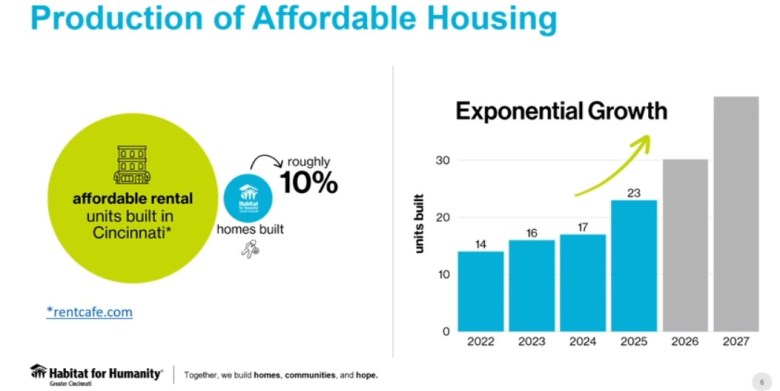
- Habitat for Humanity of Greater Cincinnati plans to “exponentially” increase their production of affordable housing by developing middle housing with the help of third-party contractors, in addition to its volunteer construction model.
- Habitat for Humanity is currently developing nine housing units, seven of which are attached townhomes, in Over-the-Rhine’s Brewery District. The project includes both new construction and historic rehabilitation.
- Habitat for Humanity built 23 new homes and repaired 174 homes in Fiscal Year2025, including numerous recent projects in East Price Hill, the West End, Evanston and Lower Price Hill.
Documenter’s follow-up question:
- Does some of Habitat for Humanity’s “economic development” work put residents at risk of displacement from gentrification?
- As Habitat for Humanity transitions to building more middle housing, will those units be more accessible to lower-income households than single-family Habitat homes have been? That is, will the median household income of Habitat homebuyers become closer to neighborhood median income?
Notes
Council member Mark Jeffreys, chair of the Housing & Growth Committee, called the meeting to order at 1:01 p.m. with the following council members in attendance:
- Mark Jeffreys
- Meeka Owens
- Jeff Cramerding
- Evan Nolan
- Anna Albi
- Seth Walsh
- Ryan James
Vice Mayor Jan-Michele Lemon Kearney arrived around 1:10 p.m. and left before the meeting ended. No members of the public were in attendance outside of presenters and this Documenter.
There was no public comment. There were no legislative items.
Habitat for Humanity Explains Development Model
Vice President of Real Estate Development Jason Chamlee and Faith and Government Relations Coordinator Te’Airea Powell presented on behalf of Habitat for Humanity of Greater Cincinnati. The presentation provided an overview of recent and planned development projects in Cincinnati and how Habitat for Humanity’s development model is changing.
Transforming Neighborhoods with Affordable Home Ownership
The majority of the affordable housing industry builds are multi-family units that low-income households are able to rent at monthly rates deemed affordable, Chamlee said. By contrast, Habitat for Humanity aims to make home ownership more affordable by building single-family homes with volunteer labor that first-time homebuyers with household incomes between 30% and 80% of area median income (AMI) can purchase. Habitat homebuyers pay a mortgage with 0% interest directly to Habitat for Humanity, which subsidizes the mortgage to a monthly payment deemed affordable.
Demand for Habitat homes outpaces supply. The number of qualifying applications that Habitat receives is about 10 times the number of houses Habitat builds, Powell said.
The median household income of Habitat homeowners in FY 2025 was about 57.21% AMI, which is much higher than the average household incomes in the neighborhoods where Habitat for Humanity builds, such as East Price Hill, West End, Lower Price Hill and Evanston. In West End and Lower Price Hill, the median household income of Habitat homebuyers is more than double the neighborhood average, according to a bar graph in the presentation.
Selling Habitat homes to households with incomes higher than neighborhood averages helps support the transformation of neighborhoods, Powell said.
Homeownership creates a pathway to generational wealth and helps neighborhoods to become more economically stable, Chamlee said.
Habitat seeks to increase production with conventional developer model
Habitat for Humanity is adopting new operational models for building affordable housing in order to see “exponential growth” in their annual production. Chamlee said Habitat will not abandon the “traditional Habitat model” of building with volunteer labor for some projects, but the model is difficult to scale up. To increase productivity, Habitat will function more like a traditional developer in several upcoming projects, which means they will hire third-party contractors to build multi-family residential buildings such as rowhouses.
Habitat is looking to collaborate with community councils and community development corporations to consider the development of Habitat homes as a community development strategy. With cohesive planning, Habitat’s development can contribute to a smooth architecture transition from more to less dense urban areas, which may appear as part of a business district revitalization strategy, Chamlee said.
Habitat is also considering cost-saving strategies, such as developing larger sites and modular construction. By developing larger sites, Habitat is able to build utility infrastructure for multiple units at one time.
Modular construction refers to the prefabrication of building components in offsite warehouses to reduce the cost and duration of onsite construction. Habitat already builds wall panels in an offsite warehouse. Habitat is in the design phase of their first modular housing project in the region, which is planned for Northern Kentucky, Chamlee said.
Recent and Planned Habitat for Humanity Projects
Most existing Habitat houses have three or four bedrooms and one or one and a half bathrooms. Habitat recently completed five houses like this on a single block on Considine Avenue and Lehman Road in East Price Hill. Homes of this model were also built in Evanston and Lower Price Hill.
In the West End, Habitat completed a row of four conjoined rowhouse units on York Street, each with three or four bedrooms and one and a half bathrooms.
Going forward, Habitat is developing nine units in Over-the-Rhine’s Brewery District in the Mohawk area. The units will include a mix of new construction and historic rehabilitation, totalling seven attached townhomes and two single-family houses. The development will bring homeownership to “a part of the city and community that has been vacant for quite some time,” Chamlee said.
Council Member Questions
Rehabilitation of Vacant Property
Council Member Mark Jeffreys asked whether Habitat for Humanity is able to work with owners of vacant property to rehabilitate existing historic buildings within their funding model.
Chamlee said that when a developer buys a vacant property to rehabilitate, available subsidies from federal, state and local governments are “based on capital expenditure,” which does not include acquisition costs. Habitat has completed some historic rehabilitation projects in Cincinnati, but new construction produces a better yield relative to cost, Chamlee said.
Accessory Dwelling Units (ADUs)
Cincinnati legalized accessory dwelling units in 2023, which the city defines as “secondary housing units on the same lot as a primary, single-family residence.”
Jeffreys asked whether Habitat for Humanity would consider constructing ADUs, which he said are an opportunity for existing homeowners to earn rental income.
Based on cost, Chamlee said it might better fit Habitat’s model to build two homes on the same property, such as one at the street and one in the rear, and then subdivide the plot for two homeowners.
Volunteer Labor and Middle Housing Construction
Council Member Anna Albi praised the transition to building more middle housing, such as rowhomes, and asked how the volunteer construction model fits into middle housing development.
Habitat uses third-party contractors instead of volunteers to build middle housing, Powell said. Habitat is able to connect volunteers to other locations.
The “traditional Habitat model” of using volunteer work is not scalable for increasing production, Chamlee said. Habitat plans to build with both the traditional and new development models in parallel.
Long-term Affordability and Residency
Albi asked whether there is a minimum duration that a Habitat homebuyer must remain in the same house. Noting that rising property taxes and utility costs pose affordability challenges to existing homeowners, Albi asked what support Habitat offers homeowners to help them remain in their homes.
Habitat for Humanity itself does not require Habitat homebuyers to retain ownership for a minimum duration, but some government subsidies do have such requirements, Chamlee said. As a result, some Habitat homes have restrictive covenants. Further, if a Habitat homebuyer does choose to sell, Habitat for Humanity has the right of first refusal.
To avoid the risk of long-term financial challenges, prospective Habitat homebuyers must apply and meet certain qualifications. Habitat considers factors such as debt-to-income ratio to assess buyer liability and “make sure they have financial cushion” before buying, Chamlee said.
The way that Habitat builds homes also accounts for long-term affordability with quality construction and materials so that their newly constructed homes are less likely to need repairs than older or less durable houses, Chamlee said.
Energy efficiency measures such as proper insulation and efficient appliances reduce utility costs, Chamlee added later, in response to a question from Council Member Meeka Owens about efficiency.
Habitat for Humanity maintains long-term relationships with Habitat homebuyers, offering coaching and sharing information about additional resources and programs such as property tax support, Powell said.
Growth to Meet Housing Demand
Noting the 10-to-1 ratio of qualified applicants to have houses built, Owens asked what happens to the other nine applicants who do not qualify.
There is more demand for housing than Habitat has the capacity to build, Chamlee said. Habitat for Humanity has set their goal for exponential growth in order to meet the need.
Owens asked for more detailed metrics on what “exponential growth” might mean for Habitat for Humanity, such as what their capacity might look like in five or 10 years.
Habitat is still developing their new vision and does not yet have specific numbers.
“Whatever that number is, we want it to be substantially, exponentially more than today,” Chamlee said.
Other Project Types
Council Member Jeff Cramerding asked whether Habitat for Humanity has ever built a mixed-income building.
“Historically no, but that concept is very much on our radar,” Chamlee said. Habitat might consider a “partner-driven” mixed-income or mixed-use project.
Cramerding asked if Habitat for Humanity might consider rehabilitating historic property and selling it at market rate to make it more financially feasible to save historic houses.
Such a project could possibly be part of a larger development initiative in which Habitat for Humanity collaborates with community partners and leverages multiple development models, Chamlee said, reiterating that Habitat for Humanity is a 501(c)(3) nonprofit.
Closing
Jeffreys motioned to file the presentation. The meeting adjourned at 2:02 p.m.
If you believe anything in these notes is inaccurate, please email us at documenters@signalcincinnati.org with “Correction Request” in the subject line.
Find more Documenters’ notes here.